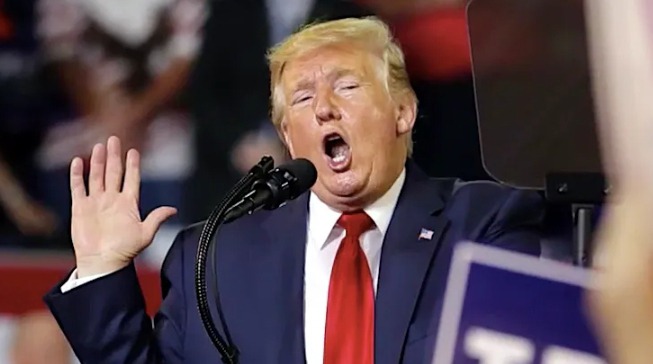
LONDON (AP) — In a ruling on Thursday, a High Court judge in London dismissed former U.S. President Donald Trump’s legal challenge against a dossier labeled “shocking and scandalous.” The dossier, compiled by ex-British spy Christopher Steele’s Orbis Business Intelligence, faced scrutiny from Trump, who sought legal action on data protection grounds.
Trump’s attempt to sue Orbis was based on allegations within the dossier, which contained unverified claims about his personal conduct, creating a political storm just before his inauguration in 2017. High Court judge Karen Steyn rejected Trump’s case, citing a six-year limitation period for damages claims.
While the court did not assess the accuracy of the dossier, it deemed Trump’s claims lacked reasonable grounds, stating he had “no real prospect of successfully obtaining such a remedy.” The dossier, commissioned by a U.S. political research firm working for Trump’s Democratic opponents, was leaked to the media in January 2017, containing explosive claims of Russia holding compromising material on Trump.
Trump vehemently denied the allegations, dismissing the dossier as “fake news” and a “witch hunt.” Steele, a former spy, defended his work as “raw intelligence” based on credible sources, arguing a duty to share findings with U.S. authorities and the media.
Trump’s lawsuit against Orbis was part of a broader legal strategy to discredit the dossier and its author. Previous lawsuits against BuzzFeed and Fusion GPS were dismissed in 2018 and 2019. Trump’s lawyers contended Orbis violated the U.K.’s Data Protection Act, seeking damages and an injunction.
Orbis countered that Trump’s suit was a “political stunt,” emphasizing legitimate research interests in a public figure. Judge Steyn sided with Orbis, deeming Trump’s claim “hopeless” and asserting a lack of evidence for harm or distress. Trump’s lawyers expressed disappointment and hinted at an appeal, maintaining confidence in the dossier’s falsity.
Orbis’s legal team welcomed the ruling, praising Steele’s professionalism and integrity, considering the dossier a valuable contribution to public understanding of the 2016 U.S. presidential election. They hailed the judgment as a “vindication” of the U.K.’s data protection law, balancing individual rights with those processing data for journalistic, academic, or literary purposes.