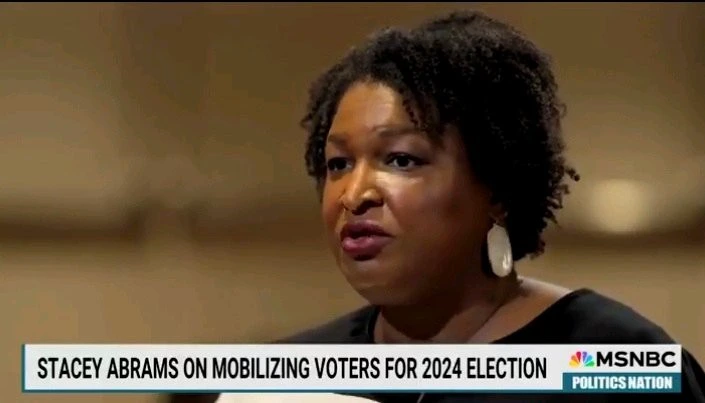
Al Sharpton on MSNBC, Stacey Abrams, a renowned Howard University professor and former Democratic gubernatorial candidate in Georgia, delivered a powerful message: “the attack on DEI is an attack on Democracy” in the United States.
With eloquence and conviction, Abrams highlighted the interconnectedness of diversity, equity, and inclusion (DEI) with the fundamental fabric of democracy and societal progress.
According to a report by The Post Millennial published on Monday, April 22, 2024, opening the dialogue with a reflection on the duality of victories and defeats, Abrams underscored the precarious nature of progress. She cautioned against complacency, asserting that triumphs should not breed a false sense of security.
“We have seen victory, but we cannot rest on that victory and think that it is impermeable and impervious to harm,” she emphasized.
Abrams then pivoted to her central thesis: the assault on DEI transcends mere policy disagreement; it strikes at the core of democracy itself.
Firm in her stance, she articulated that undermining DEI initiatives constitutes an attack on the very essence of democracy, threatening not only social cohesion but also the pillars of education and economic prosperity.
As Abrams passionately elucidated, the significance of DEI extends far beyond surface-level diversity quotas or token gestures.
It embodies a commitment to fostering an inclusive society where all voices are heard, valued, and empowered.
To assail DEI is to undermine the foundational principles of democracy, eroding the bedrock of equality and justice upon which nations strive to build.
Moreover, Abrams elucidated the symbiotic relationship between DEI and the functioning of education and the economy.
A diverse and inclusive educational landscape fosters innovation, critical thinking, and empathy, essential qualities for a thriving democracy.
By stifling DEI efforts, Abrams warned of the perilous consequences for future generations, whose access to quality education could be curtailed, exacerbating existing disparities.
Economically, Abrams argued, DEI is not merely a moral imperative but also a strategic advantage. Diverse perspectives drive creativity and problem-solving, fueling growth and resilience in an ever-evolving global market.
Conversely, neglecting DEI initiatives jeopardizes economic competitiveness, stifling progress and perpetuating systemic inequities that hinder collective prosperity.
Throughout the interview, Abrams’s impassioned rhetoric resonated with a sense of urgency, urging viewers to recognize the gravity of the moment.
She called upon citizens, policymakers, and institutions to confront the existential threat posed by the assault on DEI and to champion its principles as foundational to a robust and inclusive democracy.
As the conversation drew to a close, Abrams left viewers with a rallying cry for action. She implored Americans to stand united in defense of DEI, recognizing it not as a partisan issue but as a fundamental tenet of democracy itself.
In a time of deep political polarization and societal division, Abrams’s message served as a beacon of hope, reminding us of the enduring power of unity in the face of adversity.
In conclusion, Stacey Abrams’s bold claim that “the attack on DEI is an attack on Democracy” reverberates as a clarion call to safeguard the principles of diversity, equity, and inclusion as cornerstones of democratic governance and societal progress.
In a world fraught with challenges, her unwavering advocacy serves as a testament to the transformative potential of inclusive leadership in shaping a more just and equitable future for all.