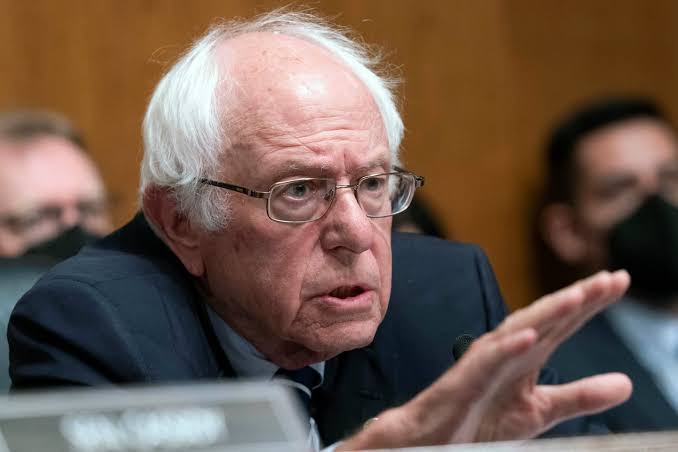
Senator Bernie Sanders ignited a fiery debate with a bold tweet on Monday, claiming a 10-year life expectancy gap between the rich and the working class in America. The Vermont senator’s statement quickly became a hot topic across social media, drawing both fervent support and sharp criticism.
On August 26, 2024, Sanders tweeted from his official account, stating, “Here’s the truth about America today: If you’re rich, you’ll live a long life. If you’re working class, you’ll die 10 years sooner. @TheoVon and I agree — it’s time to do something about that discrepancy.” The mention of comedian Theo Von, known for his satirical takes on societal issues, hinted at a potential partnership or shared concern over the issue.
The tweet quickly went viral, with many praising Sanders for highlighting a critical issue. However, the claim also attracted skepticism. Critics questioned the accuracy of Sanders’ statement, accusing him of oversimplifying a complex problem and making dramatic assertions without sufficient evidence.
Supporters, on the other hand, argued that Sanders was shedding light on a significant yet often overlooked issue: the stark differences in health outcomes between economic classes. They saw his message as a necessary call to action, particularly in the context of ongoing debates about healthcare reform and income inequality.
One Twitter user responded by raising concerns about the role of the Food and Drug Administration (FDA) in regulating food quality, particularly for canned goods and prepackaged meats. The user suggested that harmful chemicals in processed foods disproportionately impact lower-income individuals, potentially contributing to the life expectancy gap Sanders mentioned. This comment sparked further discussion about the influence of food quality on public health and the potential conflicts of interest among politicians.
Others criticized Sanders for what they perceived as a lack of concrete action. Some accused him of merely highlighting problems without offering viable solutions, reflecting frustration among progressives who feel that rhetoric alone is insufficient for meaningful change.
Not all reactions were supportive. One user expressed strong disagreement with Sanders, arguing that instead of criticizing wealth disparity, individuals should focus on wealth creation. This response echoed a common counterargument to discussions about income inequality, emphasizing personal responsibility over systemic change.
The diverse reactions to Sanders’ tweet underscore the complexity of discussions surrounding wealth inequality and its impact on society. While some view the life expectancy gap as clear evidence of systemic issues requiring government intervention, others advocate for personal responsibility and wealth accumulation as the key to improving life outcomes.
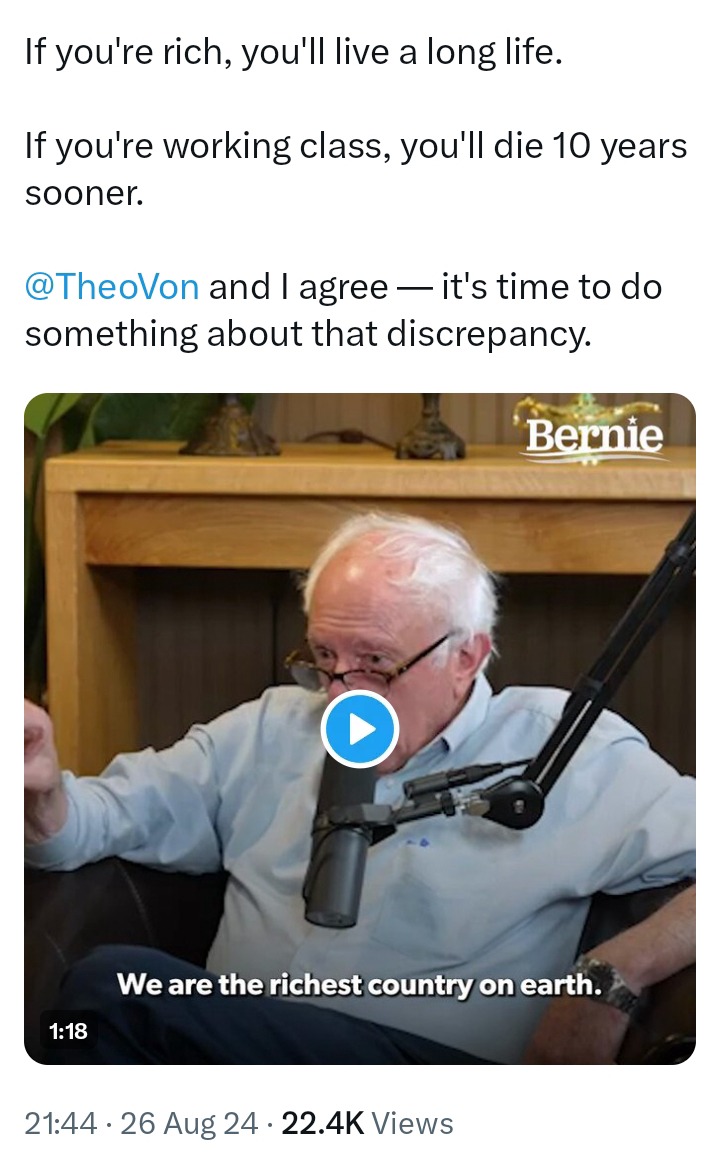
Sanders’ tweet comes amid ongoing debates about healthcare reform, income inequality, and social justice, all of which are likely to be central themes in the 2024 presidential election. The senator has long championed universal healthcare and policies aimed at reducing economic disparities, frequently citing statistics that highlight the stark differences in health outcomes between the rich and the poor.
By mentioning Theo Von, Sanders may be attempting to reach new audiences through unconventional channels, a strategy increasingly used by politicians to engage younger voters and those disillusioned with mainstream politics.
As the 2024 election draws nearer, Sanders’ focus on these issues suggests that healthcare and economic inequality will remain pivotal topics in the national conversation. His ability to stir debate with a single tweet highlights the power of social media in shaping political narratives and engaging the public in complex societal issues.
While Sanders’ tweet does not outline specific policy proposals, it reinforces his commitment to addressing what he sees as fundamental inequalities in American society. As discussions continue, it remains to be seen how these debates will influence policy-making and legislative action in the months ahead.
In conclusion, Sanders’ provocative statement has reignited conversations about the deep-rooted issues of wealth and health inequality in the United States. While his critics argue that he oversimplifies the problem, his supporters believe that such bold claims are necessary to drive awareness and spur action. As the political landscape evolves, these issues will undoubtedly play a crucial role in shaping both public opinion and policy directions.