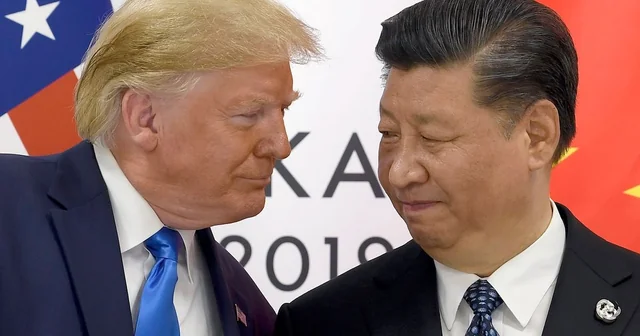
In a recent interview with podcaster Joe Rogan, former President Donald Trump openly praised Chinese President Xi Jinping, calling him “a brilliant guy.” This statement comes amidst ongoing discussions about authoritarian leadership and its implications for global politics.
During the conversation, which took place on October 26, 2024, Trump emphasized the intelligence of world leaders from U.S. adversaries. “We’re dealing with the smartest people,” he remarked, underscoring his admiration for those who wield significant control over their nations. His comments specifically highlighted Xi’s ability to manage a population of 1.4 billion people, asserting that his governance is both effective and noteworthy, regardless of one’s opinion on his methods.
“[The press] said, ‘Well, he called President Xi brilliant.’ Well, he’s a brilliant guy. He controls 1.4 billion people with an iron fist,” Trump stated, adding that such capabilities should not be dismissed lightly. His remarks sparked a mix of approval and criticism, particularly concerning the moral implications of authoritarian rule.
Rogan responded to Trump’s comments by cautioning that dictators often embody evil and pose dangers. However, Trump countered this sentiment by suggesting that there are “evil people” in America as well. “We have an enemy from within. We have people that are really bad people, that I really think want to make this country unsuccessful,” he reiterated, a phrase he has used before to describe his political adversaries.
Historically, Trump has had a complex relationship with Xi Jinping. Back in 2018, he lauded Xi when the Chinese Communist Party announced the removal of presidential term limits, allowing Xi to serve indefinitely. “He’s now president for life,” Trump noted at that time. “And look, he was able to do that. I think it’s great. Maybe we’ll have to give that a shot someday.”
This latest interview follows a pattern of Trump expressing admiration for strongman leaders. In prior discussions, he has hinted at a desire to emulate authoritarian traits, suggesting that if elected again, he might adopt a more dictatorial approach during his administration’s early days.
Trump’s remarks have reignited debates on the nature of leadership and the ethical dimensions of power. His previous comments praising figures like North Korean leader Kim Jong Un and even Nazi leader Adolf Hitler have drawn sharp backlash, highlighting the polarizing effects of his rhetoric.
In this context, Trump’s praise for Xi Jinping can be seen as part of a broader strategy to position himself as a strong leader capable of tackling the challenges posed by both foreign adversaries and domestic dissent. As the 2024 presidential campaign heats up, discussions around leadership styles and their ramifications for democracy will likely continue to dominate the political landscape.