Lithuania’s political landscape has shifted significantly following the recent national elections, as center-left opposition parties, led by the Social Democrats, celebrated a decisive victory over the center-right ruling coalition. This election marks a critical turning point for the Baltic nation, ending the four-year rule of the conservative Homeland Union government.
With 100% of votes counted from the polls held on Sunday, the Social Democrats emerged as the clear winners, securing 52 out of the 141 seats in the Seimas, Lithuania’s parliament. This victory paves the way for coalition talks aimed at forming a majority government alongside two smaller center-left parties: the Democratic Union, which gained 14 seats, and the Union of Peasants and Greens, which captured 8. Together, this coalition is expected to control at least 74 seats, a significant majority that allows them to take the reins of power.
In contrast, the outgoing Homeland Union, led by Prime Minister Ingrida Šimonytė, suffered a setback, winning only 28 seats. This unexpected outcome has prompted discussions about the shifting political tides in Lithuania, where voters historically change their allegiance every four years. Analysts had anticipated a close race, but the scale of the defeat took many by surprise.
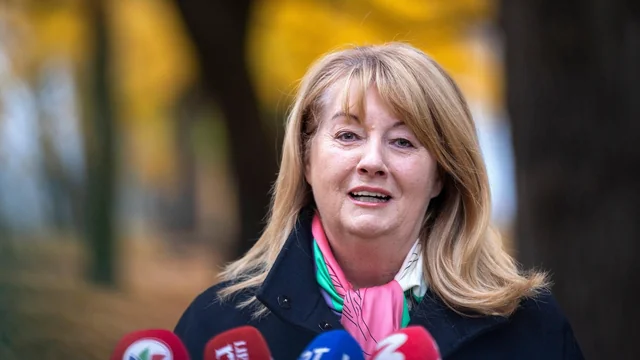
Vilija Blinkevičiūtė, the leader of the Social Democrats, expressed gratitude to supporters during a victory celebration in downtown Vilnius. “I am very grateful to the people of Lithuania who were so active today voting for us,” she remarked, highlighting the demand for change reflected in the election results. The call for a new government resonates with citizens seeking different leadership after years under the Homeland Union.
Šimonytė acknowledged the electorate’s decision, noting the historical pattern of shifting political alliances in Lithuania. “In Lithuania, that’s the way it is; every election we see the pendulum swinging in one direction or the other,” she stated, emphasizing respect for the voters’ choice.
The election took place against the backdrop of heightened tensions in the region, particularly due to Russia’s ongoing war in Ukraine. However, analysts suggest that despite the leadership change, Lithuania’s foreign policy is unlikely to undergo major shifts. As a steadfast member of the European Union and NATO, Lithuania has consistently supported Ukraine and maintained a firm stance against Russian aggression.
Criticism of the outgoing government has focused on its handling of the COVID-19 pandemic, with many citizens feeling that the government did not provide adequate support to businesses during lockdowns. Furthermore, concerns about access to healthcare and the management of migrant inflows from Belarus have also contributed to discontent with the ruling coalition.
Despite Lithuania’s impressive economic performance, including double-digit personal income growth and low inflation rates, many voters remain dissatisfied, leading to the recent electoral upheaval. The results have also rendered the populist Nemuno Aušra party, which won 20 seats, less relevant in the formation of the new government. Its leader, Remigijus Žemaitaitis, had previously resigned from parliament after making antisemitic statements.
In the wake of the election results, Gabrielius Landsbergis, Lithuania’s foreign minister and a prominent figure in the Homeland Union, announced his resignation from party leadership and his departure from politics. This further underscores the seismic shift in Lithuania’s political climate following the elections.
Voter turnout for the runoff was notably high at 41.31%, reflecting a robust engagement from the electorate eager for change. As the Social Democrats and their allies prepare to form a new government, the implications of this election will likely be felt across Lithuania for years to come.