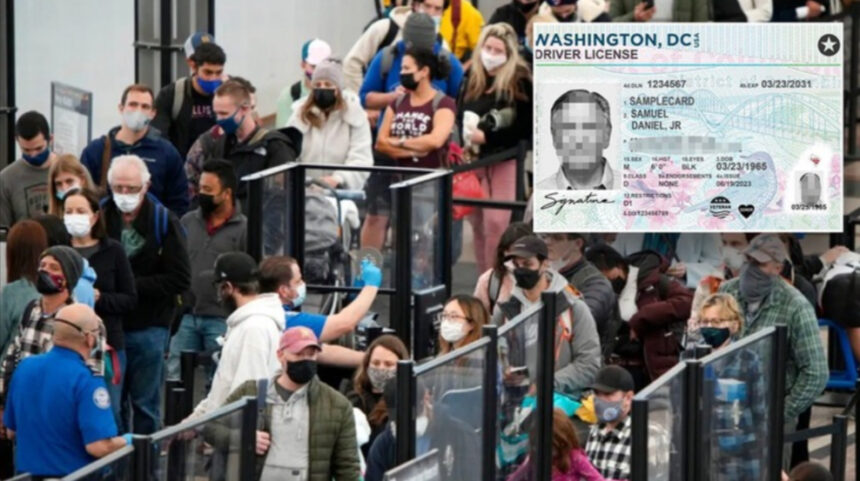
Federal REAL ID deadline looms, Americans across the country are flooding DMVs in a last-minute rush to secure compliant identification for air travel. But while legal residents scramble to meet the strict new security requirements, nearly 20 blue states and Washington, D.C., have quietly expanded access to driver’s licenses for undocumented immigrants — setting off a nationwide debate on safety, fairness, and identity.
Starting May 7, the Transportation Security Administration will require travelers to present a REAL ID-compliant driver’s license or another federally accepted ID, like a valid U.S. passport, to board domestic flights. These enhanced IDs are only available to citizens or legal residents and were mandated under the 2005 REAL ID Act, passed in the wake of 9/11 to tighten security around state-issued identification.
While the law has existed for nearly two decades, full enforcement has been delayed multiple times due to state resistance, administrative backlogs, and the COVID-19 pandemic. Now, with the final deadline approaching, the federal government is cracking down — and that includes limiting domestic air travel for undocumented immigrants.
Meanwhile, states including California, New York, Illinois, and New Jersey have implemented laws allowing undocumented immigrants to apply for standard state driver’s licenses. These licenses, while not valid for federal travel purposes, let individuals legally drive, get insured, and fulfill road safety requirements. Supporters argue the policy improves public safety and ensures accountability on the roads.
“Expanding access to driver’s licenses is a step toward a safer and more equitable New Jersey,” said Gov. Phil Murphy after signing the state’s legislation in 2019. The move led to a 65% increase in new permits within just three months, according to NJ Spotlight News.
Still, not everyone is on board. Critics say the spread of these laws could undermine the integrity of identification systems nationwide. In Massachusetts, for example, Republican Governor Charlie Baker vetoed a similar bill, warning that the state’s registry couldn’t reliably verify foreign documents. Though the bill passed via a ballot initiative, Baker argued the change diluted the trustworthiness of the state’s credentials.
The clash between state-level policies and federal enforcement has only intensified under former President Donald Trump’s renewed push to implement REAL ID. In a memo obtained by Fox News, the Department of Homeland Security emphasized that the stricter ID standards are meant to prevent undocumented immigrants from flying within the U.S., unless they are departing the country voluntarily.
“REAL ID’s enhanced verification rules make it nearly impossible to forge compliant documents,” the memo stated, pointing to past national security threats where fraudulent IDs played a role.
Some conservatives are sounding alarms not just about immigration, but about government overreach. “Big Brother is forcing us through more hoops to travel in our own country,” wrote former Alaska Governor Sarah Palin. Rep. Thomas Massie echoed the sentiment, calling the law “Patriot Act overreach” disguised as security reform.
As states juggle long DMV lines, identity verification challenges, and a heated political landscape, the REAL ID enforcement date marks a pivotal moment in the country’s ongoing immigration debate. The question at the heart of it all: Who should be allowed to drive, fly, and move freely across America — and what ID proves they belong?