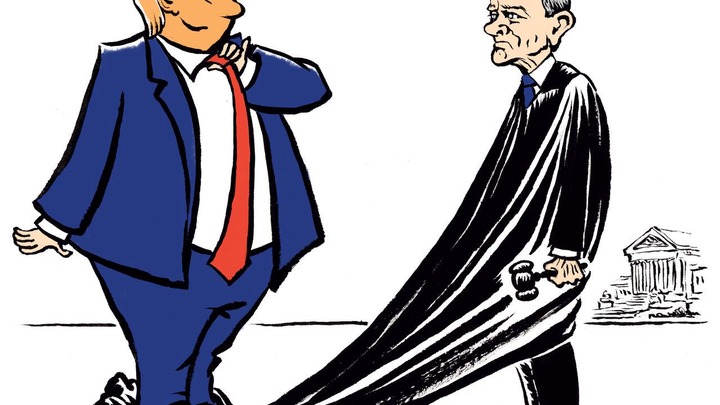
One of history’s strangest twists,President Donald Trump may be offering Chief Justice John Roberts a chance to reclaim his legacy—and redefine the Supreme Court’s role in preserving America’s constitutional order.
The contrast between the two men couldn’t be starker. Roberts, a quiet and cautious institutionalist, has spent his career building a reputation as a guardian of judicial neutrality. Trump, on the other hand, has bulldozed his way through American political norms, crafting a brand of populism that’s personal, loud, and deeply divisive. Yet, as Trump continues reshaping American politics in his image, it may be Roberts—reserved, tradition-bound, and allergic to spectacle—who holds the key to steadying the country’s legal foundations.
Now in his seventies, Roberts appears increasingly out of step with the political chaos around him. He doesn’t tweet. He doesn’t court media attention. He’s had one job for two decades and one marriage for even longer. And while Trump rallies millions with blunt-force charisma, Roberts struggles behind the bench to keep the Supreme Court above the political fray. The institution he leads has come under intense scrutiny in recent years—not just because of controversial rulings, but because of a growing perception that it’s just another partisan battleground.
When Roberts was elevated to chief justice in 2005, he set out to be a unifier—a man who could steer the Court with “judicial modesty” and protect its legitimacy. But two decades later, that vision is crumbling. Ethics scandals, political pressure, and sharp ideological splits have left the Court looking fractured. Trust in its impartiality is fading fast. And despite his instincts to stay above the noise, Roberts can’t escape the moment.
Here’s where Trump re-enters the picture—not as a role model, but as a catalyst. With Trump once again dominating the national conversation and facing a torrent of legal cases that could eventually land before the Court, Roberts is confronting a rare opportunity: to channel the very tension Trump stirs up into a reaffirmation of what the judiciary is supposed to be.
Roberts has always looked up to Chief Justice John Marshall, the 19th-century legal titan who defined the Court as a co-equal branch of government. Marshall famously defused a constitutional crisis in Marbury v. Madison, setting a precedent for judicial review without triggering a confrontation with the White House. That moment preserved the Court’s authority while avoiding political disaster. Now, with Trump challenging the boundaries of the law at nearly every turn, Roberts faces a modern echo of Marshall’s dilemma.
The stakes couldn’t be higher. Trump’s legal entanglements—ranging from election interference to civil liability—are more than political spectacles. They’re stress tests for the rule of law. If Roberts can lead the Court in handling these cases with clarity and fairness, he has a shot at doing what Marshall did: proving that the judiciary can rise above partisan warfare and serve the Constitution, not the moment.
It won’t be easy. Trump’s supporters are already primed to see any ruling against him as a witch hunt. His critics expect the Court to stand firm against democratic backsliding. And Roberts, caught in the middle, risks alienating both sides. But if he chooses to lean into the challenge—rather than retreat behind legalese and procedural fences—he might rescue more than just his own reputation. He might help restore the credibility of the Court itself.
This isn’t about political redemption. It’s about institutional survival. The Court is losing the public’s trust, and Roberts, more than any of his colleagues, knows that without legitimacy, judicial power is just ink on paper. Trump may not be the ally Roberts asked for, but he’s the one history has delivered—and through him, the chief justice might finally seize his Marshall moment.