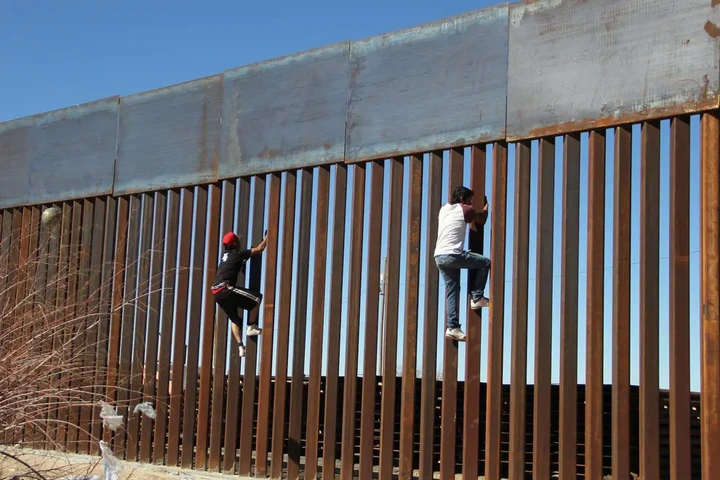
The Biden administration’s recent announcement of plans to erect novel barriers along the U.S.-Mexico border in South Texas has triggered a heated debate, leaving environmentalists and proponents of stringent border enforcement at odds.
The ambitious project, covering nearly 20 miles in Starr County, unveiled its blueprints to the public in September 2023, evoking mixed reactions from various sectors, according to a report by the Washington Times on Saturday, November 11.
Adding to the controversy, the administration waived 26 federal laws aimed at environmental protection to facilitate expedited construction, further intensifying the ongoing discourse.
Critics Dispute ‘Movable’ Design
The architectural outline of these proposed barriers, featuring a “movable” design, has faced criticism and skepticism.
Contrary to the Biden administration’s initial pledge to refrain from expanding the border wall, construction is now underway, highlighting a dissonance between campaign promises and the reality of increased migrant influx from Latin America and other regions.
Former U.S. Border Patrol chief Rodney Scott expressed disapproval, stressing that the reduced wall strength was neither requested nor endorsed by the United States Border Patrol.
Advocates for heightened border security echo Scott’s sentiments, arguing that the envisioned barriers may lack the robustness needed to deter illegal crossings.
Environmental Concerns Rise
On one end of the spectrum, environmentalists voice deep reservations about the potential consequences of the proposed design.
They argue that the “movable” barriers, though shorter than their Trump-era counterparts, pose a greater threat to animal habitats.
Concerns extend to species such as mountain lions, bobcats, and javelinas, as well as two endangered plants—Zapata bladderpod and prostrate milkweed.
Democratic U.S. Representative Henry Cuellar, representing Starr County, asserts that the flexibility of the barriers enables federal border agents to effectively manage traffic flows.
However, critics, including Scott, caution against potential vulnerabilities, emphasizing the risk of these barriers succumbing to vehicular force if not adequately anchored.
Distinctive Design
In contrast to the towering 18- to 30-foot concrete-filled steel bollard panels characteristic of Trump’s wall, Biden’s barriers take a different form.
The design, observed in Brownsville, features metal bollards embedded in 4-foot-high cement blocks tapering toward the top.
These barriers are not only shorter but also possess a temporary quality, raising questions about their long-term efficacy.
Unintended Consequences and Environmental Impact
As construction progresses, concerns about unintended consequences multiply.
Scott Nicol, a board member of the Friends of the Wildlife Corridor residing in the Rio Grande Valley, emphasizes the potential environmental impact, highlighting the risk of water obstruction during rainstorms and its adverse effects on the Rio Grande, the natural demarcation between the United States and Mexico.
Despite a recent plea from the Center for Biological Diversity and numerous other organizations urging reconsideration of environmental protection laws, the call remains unanswered.