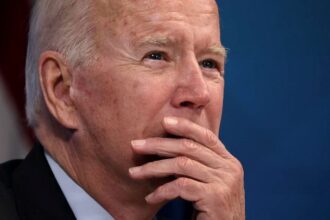
In a recent appearance on Fox News’ “The Ingraham Angle,” Wisconsin Senator Ron Johnson and Missouri Senator Eric Schmitt vehemently criticized President Joe Biden and the Democratic Party’s policies, accusing them of orchestrating a deliberate strategy leading to the deterioration of the United States.
Host Laura Ingraham questioned the senators about Harvard board member Fiona Hill’s call to support Ukraine, to which Senator Johnson responded by asserting that the nation had already witnessed a decline. He squarely placed blame on the current administration and Democrats, alleging that their pursued strategies have inflicted significant harm on the country, as reported by the Daily Caller on December 12, 2023.
Senator Johnson pointed to a range of contentious issues, including immigration policies, record-high inflation rates, efforts against fossil fuels, and the perceived mishandling of the U.S. troop withdrawal from Afghanistan. He argued that these actions not only weakened America but also emboldened adversaries such as Russian President Vladimir Putin, potentially influencing his aggressive actions in Ukraine.
Joining the critique, Missouri Attorney General Eric Schmitt attributed societal issues within the United States to what he termed the indoctrination of generations with ideologies like Diversity, Equity, and Inclusion (DEI) and Critical Race Theory (CRT). Schmitt contended that these ideologies had permeated crucial institutions, contributing to societal challenges evident on the streets and within college campuses.
While President Biden announced $200 million in pre-approved aid for Ukraine, urging Congress to pass a larger $110 billion package, House Republicans, led by Speaker Mike Johnson, have taken a firm stance. They assert that additional funding for Ukraine won’t be supported unless a deal on strengthening border security laws is reached.
The dispute over aid to Ukraine has become entwined with the broader political divide between Republicans and Democrats. Republicans are leveraging the issue to push for substantial changes to border laws before approving further funding for Ukraine. This political debate underscores the deep polarization in the United States, linking foreign aid to domestic policy priorities and highlighting ongoing struggles between the two major parties in addressing international and domestic concerns.