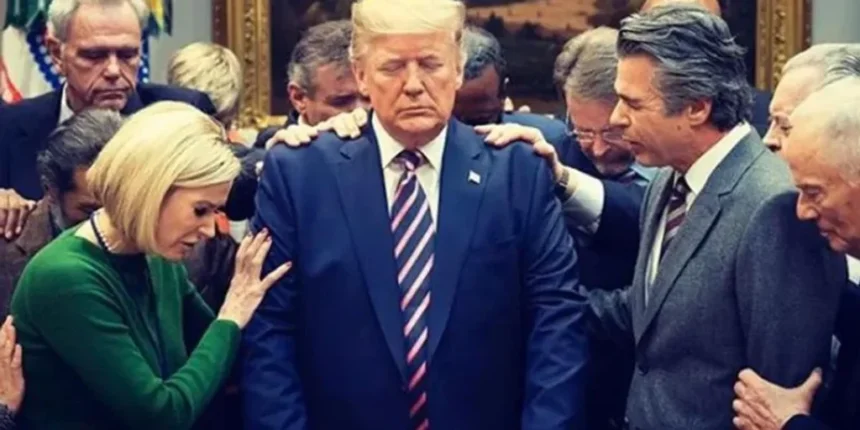
Prominent evangelical supporter of Donald Trump has expressed deep disappointment in the former president, stating that his recent actions and rhetoric have left many Christians feeling abandoned. This comes as Trump faces mounting criticism for decisions and alliances that some argue conflict with the values he once vowed to uphold.
Speaking on the condition of anonymity, the evangelical leader, who had been a vocal MAGA advocate, revealed their disillusionment in a candid interview. “It breaks my heart,” they said, “to see someone we believed in throw Christians under the bus for political expediency.”
A Shifting Alliance
Trump’s presidency had been characterized by a close relationship with evangelical Christians, a group that played a pivotal role in his election victories. He frequently courted their support with promises to champion religious freedom, anti-abortion policies, and conservative judicial appointments.
However, recent controversies have strained this bond. Critics point to Trump’s endorsements of certain candidates and policies that seem to prioritize political pragmatism over Christian principles. His perceived lukewarm stance on moral issues has raised eyebrows among those who once viewed him as a champion of their faith.
Evangelical Discontent
For many evangelicals, Trump’s decision to downplay certain social issues has been particularly troubling. “We stood by him when no one else would,” the evangelical leader lamented. “Now, it feels like he’s forgotten the promises he made to us.”
This sentiment echoes across Christian communities, where debates about Trump’s influence on the faith have become increasingly polarizing. While some still see him as a necessary bulwark against liberal policies, others worry that his focus on political gain risks alienating a core constituency.
A Crisis of Faith in Leadership
The discontent isn’t limited to Trump’s policies. Many evangelicals are questioning the broader direction of the movement that once united them. “We were never meant to blindly follow a politician,” said another faith leader. “Our mission is to uphold Christ’s teachings, not to secure political power.”
This internal reckoning could have far-reaching implications for evangelicalism in the United States. The movement has long been a cornerstone of conservative politics, but the growing dissatisfaction among its members suggests a potential shift in priorities.
Trump’s Response
So far, Trump has remained largely unperturbed by the criticism. In a recent rally, he doubled down on his achievements for the evangelical community, touting his Supreme Court nominations and efforts to protect religious liberty. “No one has done more for Christians than me,” he declared, receiving thunderous applause from his supporters.
Yet, some believe these statements ring hollow. “Words aren’t enough anymore,” the evangelical leader countered. “We need actions that align with the values we hold dear.”
Looking Ahead
As the 2024 election looms, Trump’s relationship with evangelical Christians could play a critical role in shaping his campaign. For now, the fracture within this once-unified bloc underscores the challenges of maintaining a coalition built on both faith and politics.
“It’s not too late for him to make things right,” the evangelical leader concluded. “But if he continues down this path, he risks losing the trust of those who stood by him when it mattered most.”
This growing unease raises a question that may define the future of American evangelicalism: Can faith and politics coexist without compromising the core principles of either? For many, the answer remains uncertain, but one thing is clear—the road ahead will be anything but smooth.