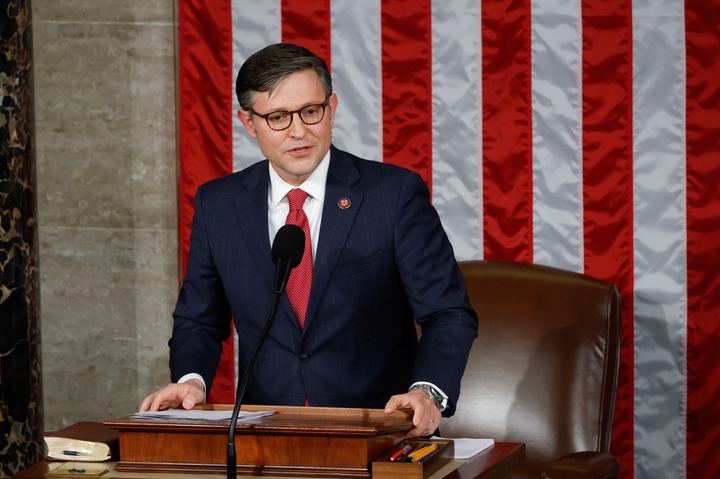
In the lead-up to the 2024 election, the Grand Old Party (GOP) finds itself on the brink of an internal clash concerning federal spending. This sets the stage for a high-stakes battle that could shape Speaker Mike Johnson’s tenure, as reported by The Hill on Monday, November 27, 2023.
Lawmakers from both sides of the aisle are anticipating a GOP showdown. House conservatives are fervently pushing for fiscal reforms, placing Johnson in the challenging position of balancing their demands with the need to sustain government operations.
After narrowly averting a shutdown with minimal impact on his leadership, Johnson faces the intricate task of managing the expectations of House conservatives. Notably, his predecessor, former Speaker Kevin McCarthy, faced criticism for relying on Democratic votes to pass a funding measure, contributing to his eventual unseating.
Despite this, House conservatives offered Johnson a degree of leniency in November, akin to a “mulligan,” for adopting a similar approach. However, signs suggest that this leniency may be short-lived. Representative Chip Roy (R-Texas) and other members of the House Freedom Caucus signal their reluctance to grant another free pass.
While Johnson’s influence is limited with Democratic control of the White House and Senate, conservatives are outspoken in their desire for more stringent fiscal policies. Roy, referring to Johnson’s compromises in passing a funding stopgap until January and February, warns that such concessions are seen as “strike one, strike two,” putting the Speaker at risk of losing his position if substantial cuts to federal spending are not secured in future deals.
As the GOP navigates this internal clash, Senate Democrats brace for a tumultuous budgetary process. Senator Richard Blumenthal (D-Conn.) expresses skepticism about any breakthrough during the December holidays, citing the House’s chaotic and divided dynamics. He voices concern about a faction of Republicans more inclined towards “throwing grenades than governing,” deeming it a “recipe for disaster.”
Senator Ron Johnson (R-Wis.), aligned with the House Freedom Caucus, echoes the urgency for substantial cuts in 2024. He points to the alarming increase in national debt over the decades, reaching $33.5 trillion, emphasizing the need for a fiscal course correction.
The tension within the GOP mirrors broader ideological divisions, with some members prioritizing fiscal responsibility while others navigate the complexities of governance in a divided government.
As the GOP braces for this internal battle royal over government spending, the outcome of this fiscal clash will undoubtedly have far-reaching consequences, not only for the party but for the nation’s economic trajectory in the critical year ahead.