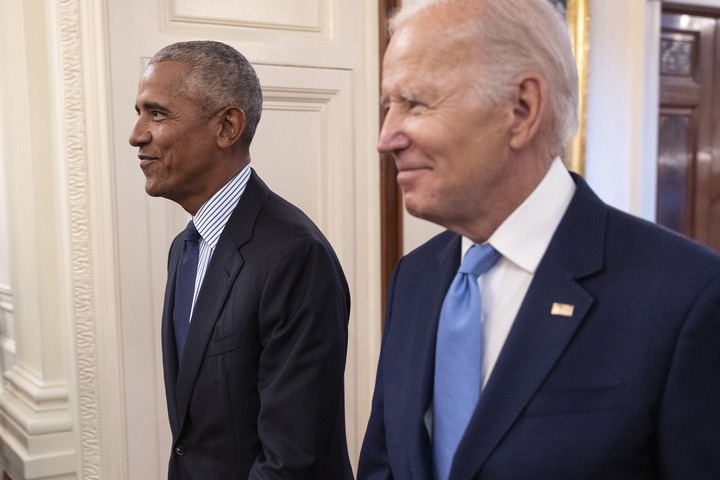
Barack Obama’s 2012 reelection campaign are causing ripples within the Democratic Party, laying bare a fundamental tension in organizational approaches between Obama and his former Vice President, Joe Biden.
While both leaders share the common goal of securing victory in the 2024 election, their divergent strategies have become a point of contention among Obama’s seasoned political veterans, as per Politico’s report on Sunday, January 14, 2024.
Concerns among Obama alumni surfaced prominently during a clandestine gathering in Chicago last year, where apprehensions were voiced regarding the perceived minimalist nature of Biden’s reelection operation.
Critics contended that Biden had yet to unveil key staff in crucial battleground states and had not dispatched top White House lieutenants to the campaign headquarters in Wilmington, Delaware.
Some raised pointed concerns about the absence of a comprehensive ground game, citing Biden’s 2020 pandemic campaign, primarily run from his Delaware residence, as a potential handicap.
“The big issue I have is Biden never had an organization before. He didn’t have much in the Dem primary. Then the general was during Covid, and no ground stuff was really done,” expressed a former 2012 battleground state director for Obama.
This sentiment is rooted in the belief that Biden cannot afford the luxury of a less robust campaign organization in a rematch against Donald Trump.
Biden’s camp, however, dismisses these concerns as overstated, pointing to recent staffing efforts in battleground states such as Michigan, Wisconsin, Nevada, and North Carolina.
They argue that the Democratic National Committee’s strengthened infrastructure, as opposed to creating an outside group akin to Organizing for America, is a strategic choice validated by the Democrats’ better-than-expected performance in the 2022 midterm election.
Obama’s approach, characterized by a sophisticated campaign machinery and a meticulous focus on analytics, sharply contrasts with Biden’s more instinct-driven style.
While Obama’s 2012 campaign drew on the expertise of key White House advisers, some critics argue that Biden should adopt a similar approach to ensure a comprehensive and effective national ground game.
“There is a treasure trove of experience in that White House. I mean, one of the issues is it’s all in the White House,” commented David Axelrod, Obama’s former chief strategist.
He suggested that Biden’s campaign could benefit from tapping into the wealth of knowledge residing in the White House, mirroring the successful strategy employed by Obama in 2011.
Biden’s camp, however, contends that his strength lies in personal relationships and an approachable demeanor, qualities that set him apart from the more technocratic Obama.
The President’s reliance on the Democratic Party machinery, especially in the early stages of his campaign, contrasts sharply with Obama’s strategy of building an independent organization.
In “The Last Politician: Inside Joe Biden’s White House and the Struggle for America’s Future,” Biden is portrayed as more down-to-earth compared to Obama’s perceived ivory tower demeanor.
The book highlights Biden’s ability to connect with voters on a personal level, a trait that has contributed to historic legislative victories.
Despite concerns among Obama veterans, Biden’s team remains steadfast in its belief that their approach is effective. They point to the 2020 victory over an incumbent, a record-breaking $1 billion campaign fundraising, and surpassing Obama’s vote count record.
However, skepticism lingers among Democrats, questioning whether these achievements were a result of external factors rather than the campaign’s structural prowess.
“The vibe was that the campaign didn’t have its shit together,” remarked a Democrat at the Obama alumni gathering about Biden’s team. “There wasn’t infrastructure in the states. There wasn’t a beefed-up campaign headquarters. And compared to where Obama was in 2011, the campaign was fairly anemic.”
As the Democratic Party grapples with internal divisions on campaign strategy, the specter of a Trump-Biden rematch looms large.
Whether Biden can successfully navigate these organizational challenges and secure victory in 2024 remains a key question, one that could shape the trajectory of American politics in the coming years.