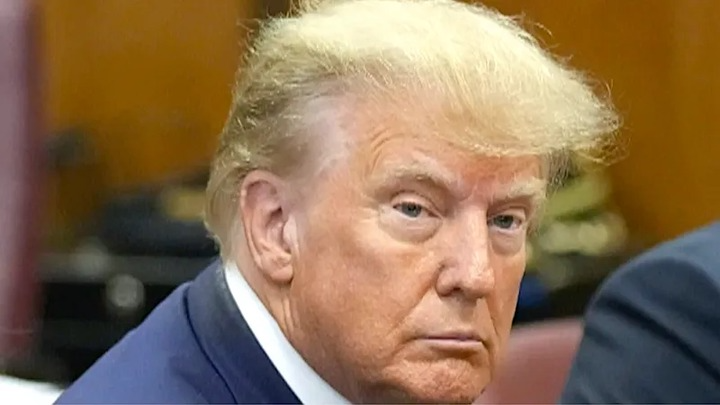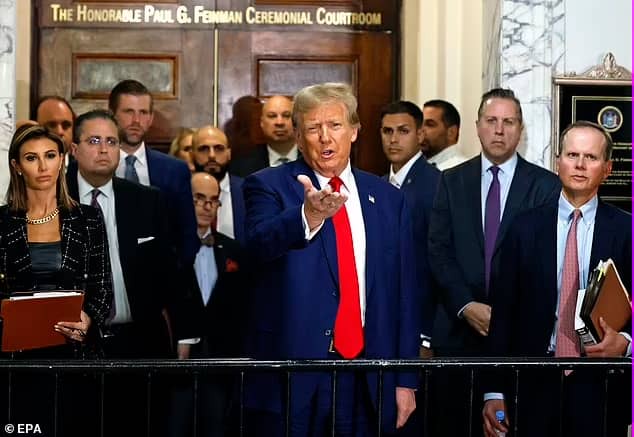
A development reported by the Daily Mail on January 12, 2024, tensions flared between the former president and Judge Arthur Engoron, who had previously curtailed Trump from straying off-topic.
Seeking assurances, Judge Engoron asked Trump to stay focused on the law and facts for a mere five minutes. However, Trump veered into a lengthy diatribe, asserting the perfection of his financial statements and decrying the case as a ‘political witch hunt.’
Insisting on damages for what he perceived as unjust treatment, Trump defended allegations surrounding the valuation of his triplex apartment at Trump Tower, dismissing it as an ‘honest mistake’ amid claims of ‘persecution.’
Critiquing the imposed limitations on his arguments, the former president claimed innocence, stating, “When you say don’t go outside of these things – we have a situation where I’m an innocent man.”
Referring to New York state, Trump asserted, “They don’t want me anymore, let’s get rid of Trump. I have a problem, I guess it’s because I ran for office,” accusing Attorney General Leticia James of bias.
Despite Judge Engoron’s attempts to maintain order, Trump persisted, prompting the judge to caution, “Mr. Kise, please control our client.”
The defense argued that the case amounted to a ‘press release wrapped up in a lawsuit,’ with concerns raised about the potential impact on Trump’s sons Eric and Don Jr’s ability to conduct business in New York.
During closing statements, Kevin Wallace from the New York State Attorney General’s office highlighted the financial challenges faced by the Trump Organization, emphasizing the importance of preferential bank rates and low-interest loans.
Wallace argued that fraudulent bank loans were crucial for the company’s survival, pointing to significant expenditures on Trump’s properties, including the Doral golf course and Turnberry in Scotland. He claimed that between 2014 and 2017, the Trump Organization faced a ‘cash crunch,’ and without such loans, the financial situation would have become ‘untenable.’
The case, seeking a $370 million fine in the civil suit, poses a severe threat to Trump’s real estate empire, potentially requiring the sale of prized properties, including Trump Tower.
Earlier, Judge Engoron had barred Trump from delivering the closing arguments himself due to concerns about staying on topic. The trial, initiated on October 2, aimed to determine the penalty for Trump’s alleged overvaluation of his net worth to secure better bank loan rates.
Christopher Kise, Trump’s lawyer, defended the former president, accusing Michael Cohen, Trump’s former personal lawyer, of being a ‘serial liar.’ Kise dismissed Cohen’s claims of fraud as “absurd and insulting.”
Highlighting the testimony of NYU Stern School of Business research professor Eli Bartov, Kise argued that Bartov found ‘no indication of financial reporting misconduct.’ Kise contended that Trump, with his extensive real estate experience, should be considered an ‘industry expert.’
The defense criticized the Attorney General’s valuation of Trump’s properties, including Mar-a-Lago and Trump Tower. Kise argued that the valuation of Mar-a-Lago at $27 million was ‘absurd,’ asserting a much higher value based on expert witnesses.
In a plea to the judge, Kise warned that ruling against Trump could set a dangerous precedent, potentially prompting businesses like JP Morgan to leave New York to avoid similar prosecutions. He argued against a ‘victimless fraud’ and the imposition of a ‘corporate death penalty.’
Judge Engoron expressed skepticism regarding some of Kise’s arguments and, at the end of the 90-minute argument, acknowledged it as a ‘feat of endurance.’
The final ruling on the penalty is anticipated in the coming weeks, marking a critical juncture for Trump’s real estate business and financial future.