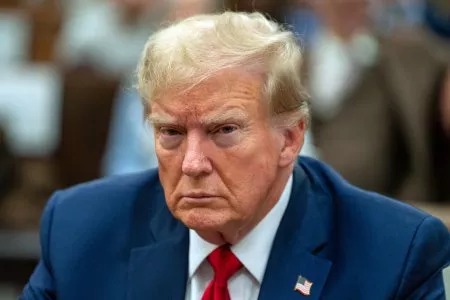
Donald Trump, the former president and current front-runner for the 2024 Republican presidential nomination, confronts the ominous possibility of being the first ex-president sentenced to prison. A total of 91 criminal charges spanning federal and state jurisdictions, including mishandling classified documents, orchestrating hush money payments, and attempting to overturn the 2020 election results, form the backdrop of a legal battle that could reshape the course of American political history.
Trump vehemently pleads not guilty, denouncing the allegations as politically motivated, according to a report by Newsweek on Saturday, December 9.
The stage is set for a legal showdown that raises questions about Trump’s future behind prison walls. Legal experts and prison authorities offer insights into potential scenarios, delving into the complex decisions that lie ahead.
Former federal prosecutor Neama Rahmani underscores the unique risks to Trump’s safety, emphasizing the necessity of placement in a minimum-security facility. Rahmani highlights the Bureau of Prisons’ authority in determining housing for federal inmates, limiting the influence of judges in this crucial decision.
In Georgia, where state-level charges are pending, the Department of Corrections faces a similar dilemma regarding Trump’s potential incarceration—weighing options between state prison, private facilities, or a detention center.
Contrary to Rahmani’s perspective, Robert Rogers, an associate professor of criminal justice and former BOP employee, envisions Trump being sent to a maximum-security penitentiary to prevent any attempts by fervent supporters to liberate him. This possibility raises concerns regarding Trump’s guaranteed Secret Service protection for life, underscoring the need to ensure that any detention facility adheres to legal standards.
Rogers emphasizes that the focus should be on upholding the principles of the justice system, irrespective of the detainee’s status. The potential detention of a former president, shrouded in legal intricacies, demands meticulous attention to avoid compromising the integrity of the justice system.
The delicate balance between Trump’s safety and mental health adds another layer to the complex equation. An undisclosed authority, referred to as Gober, highlights the challenge faced by prison authorities: isolating Trump from potential threats while mitigating the adverse effects of prolonged seclusion on his mental well-being.
As the legal saga unfolds, the specter of Trump serving time in prison introduces unprecedented challenges for the justice system. The decisions regarding his incarceration will not only shape his legacy but also test the resilience of American institutions in the face of such a unique and contentious scenario.
In the end, whether Trump walks into a minimum-security facility or a maximum-security penitentiary, the repercussions of his potential imprisonment extend far beyond his personal fate. They touch the very fabric of the nation’s commitment to justice, fair treatment, and the rule of law.