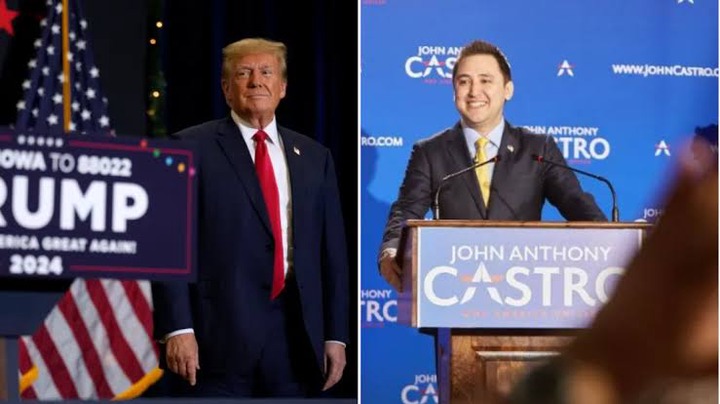
John Anthony Castro, the Texas presidential candidate who fervently contested Donald Trump’s 2024 ballot eligibility, now finds himself entangled in a web of legal troubles. A recent announcement by the Justice Department reveals that the 40-year-old has been indicted on 33 counts of filing fraudulent tax returns, casting a shadow over his political aspirations.
Castro, known for his numerous legal challenges attempting to prevent Trump from appearing on the ballot, faces accusations of orchestrating a scheme through his virtual tax preparation business, Castro & Company LLC. The alleged wrongdoing spans multiple locations, including offices in Orlando, Florida, Mansfield, Texas, and Washington, D.C.
Federal prosecutors assert that Castro enticed taxpayers with promises of “significantly higher” tax refunds, often pledging to share the additional refund with them. The charges detail a sophisticated operation involving the fabrication of false deductions without taxpayers’ knowledge, resulting in inflated refunds.
This fraudulent tax scheme reportedly persisted over several years, impacting numerous unsuspecting taxpayers and leading to hundreds of thousands of improperly paid claims. The Justice Department’s investigation reached a pivotal moment when an undercover federal agent, posing as a taxpayer seeking assistance, engaged Castro in 2018.
During a recorded telephone conversation, Castro allegedly proposed projecting a potential tax refund from another firm and then comparing it with the refund he could secure. Despite the agent denying any facts supporting deductions, Castro filed a tax return on March 14, 2018, claiming nearly $30,000 in fraudulent deductions. The IRS issued a refund of $6,007, with Castro receiving $2,999 for his services and the agent receiving the remaining amount of $3,008—significantly more than the $300 deduction Castro had suggested the agent would receive from another tax preparer.
It has been revealed that despite Castro’s claims of being a ‘federal practitioner’ and an ‘enrolled agent’ with the IRS, he is not licensed to practice law in the United States. Each count in the indictment carries a potential maximum sentence of three years in prison.
This legal turmoil not only threatens Castro’s credibility but also raises questions about his political standing. Despite positioning himself as a conservative alternative to the former president, these charges have cast a dark cloud over his campaign.
Notably, Castro’s legal battles against Trump in 27 states, aimed at preventing the former president from appearing on the ballot, face a peculiar twist. While none of his challenges succeeded, recent efforts, such as the Colorado Supreme Court ruling that Trump is ineligible, have gained traction and are now under consideration by the Supreme Court.
At the core of these legal challenges is the Constitution’s 14th Amendment, Section III, which bars candidates engaged in insurrection or rebellion from holding office. Trump, facing legal scrutiny for his alleged role in inciting violence at the U.S. Capitol on January 6, 2021, confronts a barrage of legal challenges questioning his eligibility for the 2024 ballot. As the legal proceedings unfold, the intersection of Castro’s legal battles and his own legal troubles presents a compelling narrative of political and legal complexity.