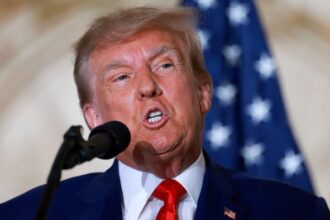
The U.S. federal government’s total public debt has surpassed the monumental threshold of $34 trillion, leaving even former President Trump notably silent in response. This momentous financial revelation, disclosed by the U.S. Treasury Department, sets the stage for another round of federal funding battles on Capitol Hill in the weeks to come.
As reported by Newsmax on Wednesday, January 3, 2024, the Daily Treasury Statement for Friday revealed an increase in the total public debt outstanding, rising from $33.911 trillion on Thursday to an alarming $34.001 trillion. Notably, a critical subset of this figure, termed “debt subject to limit,” escalated from $33.794 trillion to $33.89 trillion on Friday, excluding certain components such as the unamortized discount on Treasury bills and zero coupon bonds, as well as debt issued by the Federal Financing Bank and guaranteed debt of specific agencies.
This financial milestone closely follows the federal debt crossing the $33 trillion mark in September, a consequence of mounting federal deficits driven by diminishing tax revenues and escalating federal expenditures.
As Congress readies itself for the challenges ahead, two significant deadlines on January 19 and February 2 for settling government spending through September loom on the horizon. Adding complexity to the situation are Republican demands to reduce fiscal 2024 discretionary spending below caps agreed upon in June.
The potential for a government shutdown further complicates matters, with failure to approve fiscal 2024 spending bills risking the shutdown of Washington agencies. Compromise becomes increasingly challenging with the specter of the November presidential and congressional elections swiftly approaching.
Maya MacGuineas, president of the Committee for a Responsible Federal Budget, a fiscal watchdog group, expressed deep concern over the $34 trillion federal debt figure. She characterized it as a “truly depressing achievement,” attributing it to the unwillingness of political leaders to make difficult fiscal choices. In a statement, MacGuineas emphasized the urgent need for policymakers to take measures to reduce borrowing, advocating for a combination of raising taxes, reducing spending, and potentially creating a fiscal commission.
In response to the escalating debt, White House spokesperson Michael Kikukawa placed blame on “trickle-down debt” driven by Republican-passed tax cuts in 2017. According to Kikukawa, these tax cuts primarily benefited corporations and wealthy Americans. He accused Congressional Republicans of wanting to further this economic approach with over $3 trillion in giveaways skewed towards the wealthy. Kikukawa contended that the proposed measures would force hardworking Americans to bear the brunt by cutting into Social Security, Medicare, and Medicaid.
In contrast to the Republican approach, Kikukawa highlighted President Biden’s plans to address the escalating deficits. Biden aims to reduce U.S. deficits by $2.5 trillion over the next decade, presenting a contrasting vision amid the escalating economic challenges.