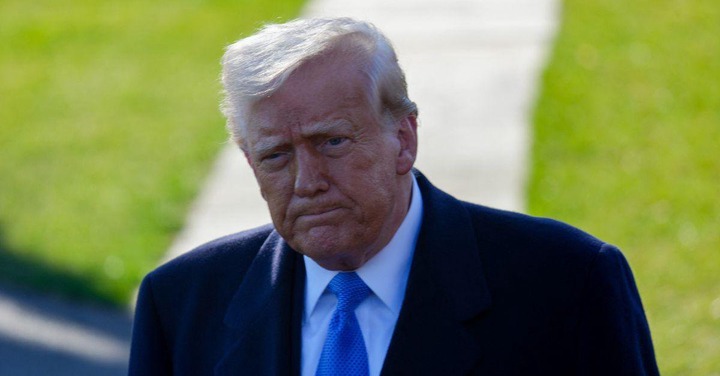
Donald Trump’s mental health has become a major point of discussion, with growing concerns that he may be grappling with dementia. Psychotherapist Dr. John Gartner has raised alarms about the former president’s cognitive decline, citing worrying signs such as his increasing difficulty finishing sentences and engaging in coherent speech.
Dr. Gartner, known for his expertise on mental health, has been outspoken about the possibility that Trump is suffering from Alzheimer’s disease. In a recent interview, he detailed the symptoms that have caused him to worry, including Trump’s frequent rambling, confusing thoughts, and bizarre associations. “When diagnosing dementia, one key factor is the deterioration of a person’s baseline functioning,” Dr. Gartner explained. “Trump, in his prime, was articulate and spoke with clarity. Today, he struggles to complete even basic thoughts.”
The psychotherapist went further, pointing out that Trump’s speeches have become erratic, with frequent shifts from one topic to another—mentioning everything from Venezuelans and mental hospitals to sharks and the fictional Hannibal Lecter. These off-topic tangents are a red flag, according to Gartner, who noted that such disjointed thinking is characteristic of brain damage or dementia.
Gartner’s concerns also extend to Trump’s speech patterns. He pointed to numerous instances where Trump misuses words, such as calling missiles “mishiz” or Christmas “Chrishus,” a sign of phonemic paraphasias, a condition often linked to dementia. The frequency of these verbal mistakes, combined with his tendency to incorrectly use words like “oranges” instead of “origins,” suggests that Trump’s cognitive abilities may be rapidly deteriorating.
In addition to Dr. Gartner’s analysis, other mental health experts have voiced similar concerns, and a recent computer analysis of Trump’s speeches further confirms a disturbing trend. The analysis found that his rally speeches are now nearly twice as long as they were during his first term, often full of rambling, incoherent statements. His increased reliance on absolute terms like “always” and “never” is also seen as indicative of his aging process and potential cognitive decline.
Even former White House communications director Anthony Scaramucci has pointed to a noticeable drop in Trump’s ability to craft powerful, clear sentences. “He’s lost the ability to string together meaningful, impactful language,” Scaramucci remarked, further fueling fears about the former president’s mental state.
Despite these concerning signs, Trump has hinted at the possibility of running for a third term in office, relying on a controversial interpretation of the 22nd Amendment. This twist in his political ambitions has raised eyebrows, with some speculating that if Vice President J.D. Vance ascends to the presidency, Trump could return as vice president and, in a bold move, resign upon taking office.
As the debate over Trump’s fitness for office rages on, the question remains: is the establishment ‘sanewashing’ the reality of his deteriorating mental state? Only time will tell.