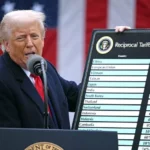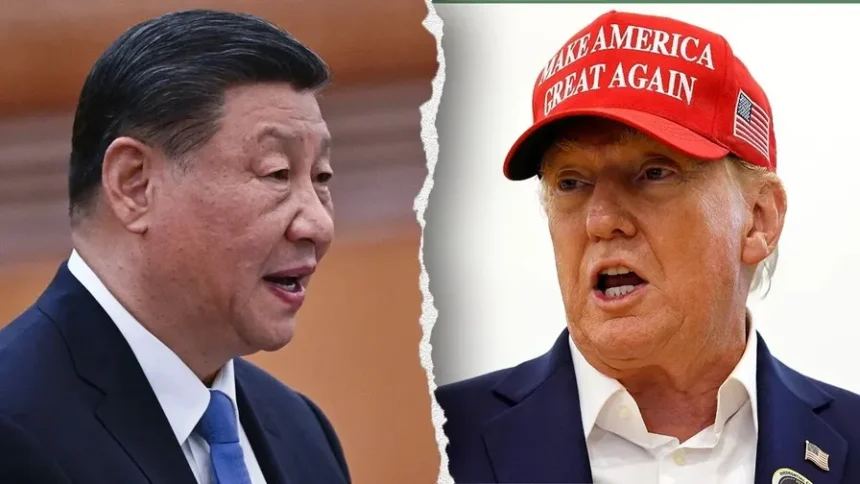
President Donald Trump has threatened to impose a staggering 50% tariff on Chinese goods if Beijing refuses to back down from its recently announced 34% retaliatory tariffs. This move, which could drastically reshape global trade dynamics, is scheduled to take effect if China doesn’t reverse course by April 8, 2025.
The high-stakes standoff comes after China introduced a 34% tariff on U.S. imports, a direct countermeasure to Trump’s “Liberation Day” tariffs. Trump responded on social media, saying that if China didn’t withdraw its new tariffs, the U.S. would retaliate with a significant hike, bringing tariffs to an eye-popping 50%. Furthermore, Trump stated that all ongoing discussions with China regarding trade talks would be immediately suspended, signaling a shift in U.S. diplomatic efforts.
Trump’s latest rhetoric is a continuation of his stance against what he has labeled China’s long-standing trade abuses. He described China as the “biggest abuser” of tariffs, claiming that despite lower oil prices, reduced interest rates, and the absence of inflation, the U.S. continues to reap billions of dollars from tariffs imposed on China. Trump reiterated that these tariff impositions were a response to China’s persistent market manipulation, illegal subsidies to its companies, and currency manipulation—accusations that have long strained relations between the two superpowers.
This latest move by the U.S. has drawn sharp criticism from China. The Chinese government condemned Trump’s actions as “economic bullying” and warned of global backlash. According to China’s foreign ministry, the tariffs violate basic economic principles and reflect the U.S.’s efforts to use trade policies as leverage to pursue an America First agenda. Chinese officials are accusing the U.S. of undermining the international economic order with its aggressive stance, describing the U.S. move as unilateral and driven by protectionism.
Despite this, Trump has remained defiant, emphasizing that China has “taken advantage” of the U.S. for decades, with little resistance from past administrations. His message is clear: the U.S. is no longer willing to tolerate what it perceives as unfair trade practices. Trump also pointed out that the U.S. is in discussions with several other countries, including Japan, to form new trade deals that would better serve American interests.
As the U.S.-China trade war intensifies, China has doubled down on its tariffs, which are set to go into effect on April 10. In response, Chinese state media has adopted a combative tone, with the People’s Daily declaring that “the sky won’t fall” and reassuring the Chinese public that the country is fully prepared to weather the economic storm.
With both sides in a stalemate, the fate of the trade relationship between the U.S. and China hangs in the balance. The world watches closely as this high-pressure trade drama continues to unfold.