


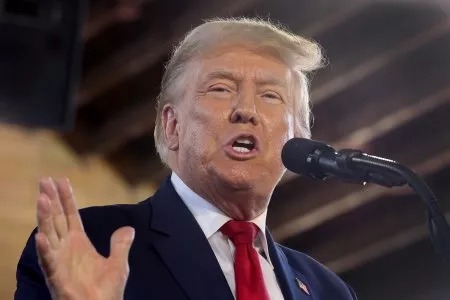
Former President Donald Trump’s legal team has unveiled a bold assertion in Fulton County Superior Court, suggesting that Trump may be shielded from the election-related charges if he secures victory in the 2024 election. The claim, rooted in the concept of presidential immunity, posits that Trump’s trial could potentially be delayed until after a hypothetical second term in office.
Lead attorney Steven Sadow, confident in this legal strategy, not only predicted the trial’s outcome but also asserted that if Trump were to win the 2024 election, the trial might not commence until after the conclusion of his second term. During a recent hearing, Sadow explained, “Under the supremacy clause and his duty as president of the United States, this trial would not take place at all until after he left his term of office.”
This legal argument delves into the intricate interplay between constitutional provisions, particularly the supremacy clause, and the complexities surrounding the prosecution of a sitting or former president.
Legal scholars, acknowledging the nuanced nature of this claim, highlight its complexity and the potential constitutional intricacies it brings to light. This legal strategy, exclusive to Trump and contingent on his electoral success, adds uncertainty to the already intricate legal proceedings.
Sadow’s reference to presidential immunity is pivotal to this strategy, suggesting that federal obligations could supersede state-level legal proceedings, providing a shield against certain charges during a president’s term in office.
In an unexpected turn during the hearing, Judge Scott McAfee raised the possibility of separating defendants into two distinct trials, adding another layer of complexity to the case. While no definitive decisions were made, this suggestion underscores the multifaceted nature of Trump’s legal challenges.
Outside the courtroom, Sadow’s reference to presidential immunity sparked extensive discussions among legal analysts, further complicating the situation and prompting debates on the most suitable course of action.
The ongoing legal saga, framed by some as election interference, introduces layers of complexity to the high-profile battle surrounding Trump’s indictment in Georgia. As events continue to unfold in Fulton County Superior Court, the intricate legal arguments, the potential impact of presidential immunity, and the broader implications of the case will likely remain at the forefront of legal debates and public discourse.
During the recent hearing, attorneys representing other defendants presented a spectrum of legal arguments, from seeking extensions to filing deadlines to advocating for the complete dismissal of charges. Some argued for the right to question the 2020 election results, emphasizing the importance of free speech rights in political discourse.
Despite the diverse legal strategies presented, Judge McAfee refrained from making a ruling on the timing of the trial, scheduling further discussions for mid-December. This ongoing legal saga, with its intricate legal arguments and the potential impact of presidential immunity, will undoubtedly shape the trajectory of this case and influence broader conversations about the intersection of legal proceedings and political controversies in the United States.


