Former President Donald Trump found himself on the defensive during an interview with Bloomberg News Editor-in-Chief John Micklethwait at the Economic Club of Chicago. The conversation took a heated turn when Micklethwait pressed Trump about the estimated $7 trillion deficit increase linked to his proposed policies, a figure Trump dismissed with a flurry of insults.
The Tense Exchange
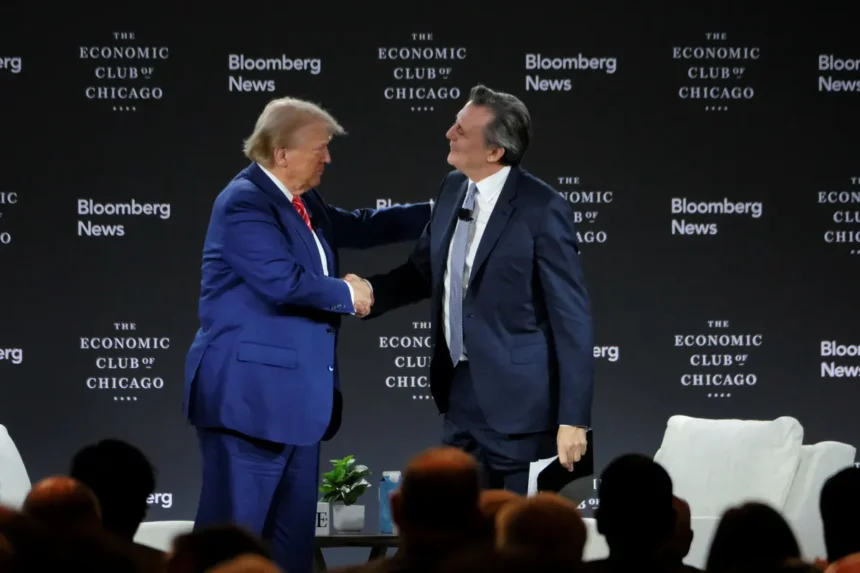
The interview, which took place on October 15, 2024, saw Trump shaking hands with Micklethwait before taking to the stage. Micklethwait highlighted that his estimate of $7 trillion was considered “quite kind,” noting that the upper estimate could reach a staggering $15 trillion according to the nonpartisan Committee for a Responsible Federal Budget. This figure sparked Trump’s irritation.
“I was actually quite kind to you,” Micklethwait stated, only to be cut off by Trump, who quickly dismissed the claim. The former president’s frustration grew as Micklethwait mentioned that even the Wall Street Journal, a publication not typically known for its liberal stance, criticized Trump’s financial plans.
Dismissive Responses
As Micklethwait explained the financial implications of what Trump referred to as “Trump Trade,” which describes market reactions to his proposed economic policies, Trump crossed his arms and interrupted. Micklethwait pointed out that the Wall Street Journal had projected Trump would add approximately $7.5 trillion to the national debt, double the expected impact of Vice President Kamala Harris’ plan.
“You are running up enormous debts,” Micklethwait said. Trump, unfazed, shrugged and retorted, “What does the Wall Street Journal know?”
A Hostile Back-and-Forth
The tension escalated as Trump insisted he wanted clarity on the matter but repeatedly interrupted Micklethwait’s attempts to explain. “They’ve been wrong about everything,” Trump asserted, before aiming his criticism directly at the interviewer. “So have you, by the way,” he snapped, prompting laughter from the audience.
Micklethwait attempted to reframe the conversation, stating, “You’re trying to turn this into a debate.” To which Trump replied, “It’s not a debate. You’re wrong. You’ve been wrong all your life on this stuff.”
Implications of the Exchange
This exchange highlights not only Trump’s contentious relationship with the media but also his approach to economic discussions as the 2024 presidential race heats up. With mounting concerns over the national debt and inflation, Trump’s responses may raise questions among voters about his fiscal responsibility. As the election approaches, how candidates address these critical economic issues will play a pivotal role in shaping public perception and voter decisions.