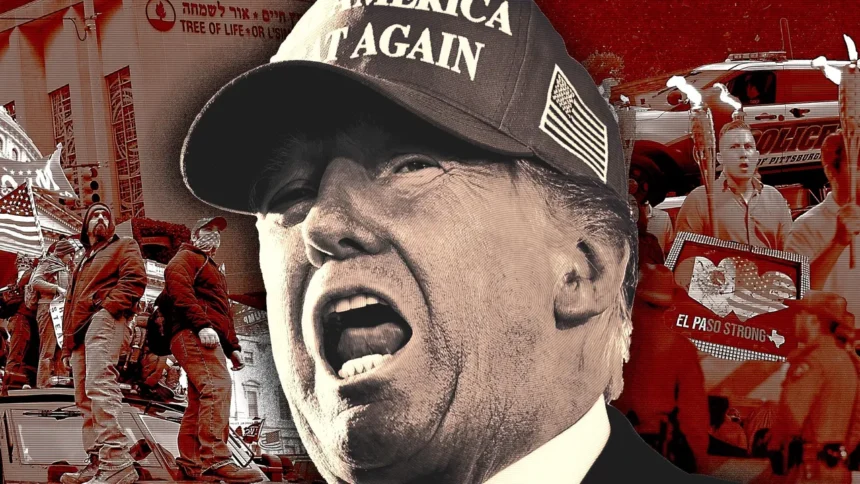
Donald Trump’s rhetoric during the 2024 campaign raises alarming parallels to extremist language used by white supremacists. Experts warn that his speeches instill fear among followers, positioning himself as their only savior in a threatening world. This dangerous strategy could lead to increased violence, reminiscent of past hate-driven actions.
Historically, Trump’s campaigns have included derogatory remarks about immigrants, notably calling Mexican immigrants “rapists” in his 2016 bid. However, his current rhetoric has escalated dramatically, prompting political observers to openly label him a “fascist.” Ernesto Castañeda, a professor at American University, reflects on how some were hesitant to use such terms early on, but now see a clear alignment with fascist ideologies.
During a recent rally in Aurora, Colorado, Trump’s inflammatory comments echoed the hateful speeches of the past. He described the United States as an “occupied state” and advocated for severe punishments for immigrants. His claims about crime rates among immigrants are not just exaggerated; they are rooted in debunked narratives that stoke fear and division.
One particularly disturbing assertion by Trump involved the accusation that Haitian migrants were “eating their neighbors’ pets,” a false claim linked to white supremacist groups. His ongoing narrative of immigrants as inherent criminals taps into long-standing racist ideologies, suggesting that their “bad genes” lead to criminal behavior. This rhetoric not only misrepresents immigrant communities but also fosters an environment ripe for violence.
As the election approaches, Trump’s strategy seems to be to double down on fear. He has indicated that he plans to intensify his attacks, suggesting that softening his approach would be detrimental to his campaign. Castañeda warns that rhetoric like Trump’s has real-world consequences. He cites the 2019 El Paso shooting, where a white supremacist targeted Hispanics, linking it to the toxic environment cultivated by Trump’s words.
Susan Benesch, director of the Dangerous Speech Project, argues that Trump’s rhetoric does not merely incite hatred; it capitalizes on fear. By portraying various groups as threats, he positions himself as the sole protector of his supporters. This tactic creates a sense of urgency and drives people to vote, potentially pushing some to act violently beyond the ballot box.
The right-wing media landscape plays a crucial role in amplifying Trump’s messages. Benesch compares it to the media’s influence during the Rwandan genocide, where inflammatory language paved the way for mass violence. She emphasizes that constant exposure to extremist rhetoric can condition individuals to respond violently, highlighting the need for awareness and caution.
Recent polling by the Public Religion Research Institute indicates a concerning trend: a significant portion of Americans, particularly Republicans and white evangelical Protestants, show openness to authoritarian ideas. With four in ten Americans susceptible to such appeals, the potential for political violence looms large as the election nears. Robert P. Jones, PRRI’s president, warns that these findings should alarm those invested in the preservation of American democracy.
As Trump continues to rally his base, his use of fear and divisive language poses a real threat not just to his opponents, but to the very fabric of society. If unchecked, this rhetoric could inspire violence, as history has shown us time and again. The stakes are high as America heads toward a crucial election, one that could define the nation’s future.