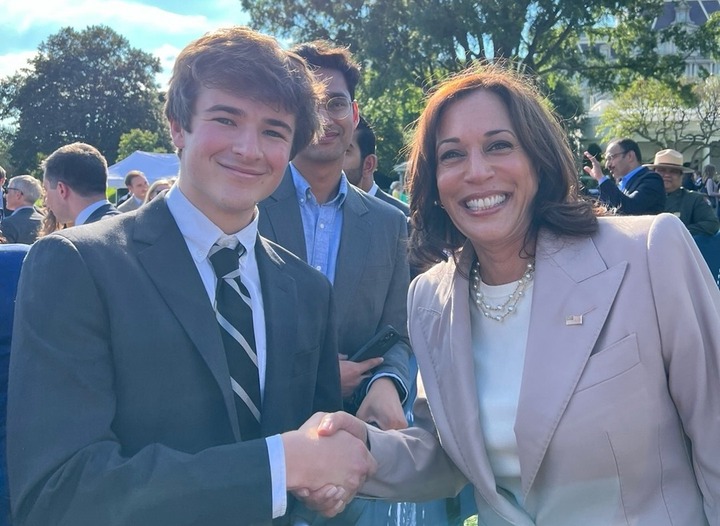
Monday, August 5, Harry Sisson, a 21-year-old university student known for his vocal support of Vice President Kamala Harris and President Joe Biden, took to social media to criticize former President Donald Trump’s campaign schedule.
Sisson, who recently had the opportunity to interview President Biden, shared a comparison of the upcoming week’s campaign activities for both Harris and Trump with his large follower base. The young political enthusiast highlighted the stark contrast between the two candidates’ schedules.
According to Sisson’s post, Vice President Harris has planned an ambitious tour covering nearly all swing states in the coming week. Her itinerary includes rallies in Pennsylvania on August 6, Michigan and Wisconsin on August 7, North Carolina on August 8, Arizona on August 9, and Nevada on August 10.
In contrast, Sisson pointed out that Trump’s schedule for the same period shows only one campaign stop, set for August 9 in Montana. Sisson didn’t hold back in his critique, stating, “Look at this. Kamala Harris is hitting the campaign trail, making stops in almost every single swing state this week. Donald Trump, on the other hand, has one campaign stop. Low energy, Trump!”

This comparison has sparked discussions about the different campaign strategies employed by the two camps. Harris’s aggressive push in swing states suggests a focused effort to engage with voters in crucial battleground areas. These states, including Pennsylvania, Michigan, Wisconsin, North Carolina, Arizona, and Nevada, are often considered pivotal in determining the outcome of presidential elections.
Trump’s single rally in Montana, a state that has consistently voted Republican in recent presidential elections, raises questions about his campaign’s current priorities and resource allocation. Sisson’s comments have gained traction online, with many of his followers and political commentators weighing in on the significance of these contrasting schedules. Some view Harris’s packed itinerary as a sign of the campaign’s vigor and determination, while others speculate about the reasons behind Trump’s more limited public appearances.
As a young, politically engaged voice, Sisson’s observations carry weight among his peers and highlight the increasing role of social media in shaping political narratives. His recent interview with President Biden has further elevated his profile in political circles.
As the 2024 presidential race heats up, the candidates’ campaign strategies, including their public appearances and engagement with swing states, will undoubtedly be under intense scrutiny. This early comparison of schedules may set the tone for how each campaign’s energy and outreach efforts are perceived in the coming months.