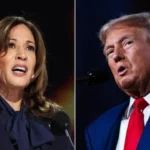
Recent polling reveals a striking perception among Americans regarding former President Donald Trump, with half of the country identifying him as a fascist. This finding, stemming from an ABC News/Ipsos survey, highlights deepening concerns that have emerged amid the current political climate, especially in light of comments from Vice President Kamala Harris and former officials from Trump’s administration.
Poll Findings on Trump’s Reputation
The ABC News/Ipsos poll indicates that 49% of registered voters consider Trump a fascist, which the survey defines as a political extremist who acts as a dictator, disregards individual rights, and threatens or uses force against opponents. In contrast, only 22% of respondents label Harris with the same term. This stark difference underscores a significant divide in how each candidate is viewed.
Further insights from the poll show that nearly two-thirds of those surveyed believe Trump frequently departs from the truth, compared to 49% who feel the same about Harris. Despite Trump facing heavier criticism for truthfulness, Harris draws scrutiny for allegedly pandering to voters with insincere policy proposals. This dynamic illustrates the challenges both candidates face as they navigate a heated election campaign.
Perception of Fascism Linked to Partisanship
The perception of Trump as a fascist varies greatly along partisan lines. A notable 87% of Democrats classify him as such, while only 12% of Republicans agree. Among independents, 46% share the view. Conversely, 41% of Republicans see Harris as a fascist, whereas just 3% of Democrats agree. This partisanship highlights the polarized nature of American political discourse today.
Moreover, among registered voters who support Harris, 87% label Trump a fascist, while only 42% of Trump supporters apply the same label to Harris. This divide indicates a strong ideological rift in how each candidate’s supporters perceive threats to democracy.
Truth-Telling and Election Concerns
The survey also sheds light on broader concerns surrounding each candidate’s honesty. An overwhelming 65% of registered voters claim Trump often makes untrue statements. This perception persists even among some of his own supporters, with 30% acknowledging his frequent dishonesty. In contrast, Harris faces lesser scrutiny, with 49% viewing her statements as frequently untrue.
Both candidates struggle with public trust regarding their intentions and proposed policies. Voters perceive Harris as more likely to propose policies aimed solely at gaining votes rather than genuine commitment, a sentiment shared by 57% of registered voters. Trump’s similar tendencies receive a marginally lower critique, with 52% of respondents expressing skepticism about his sincerity.
Crisis Perception in Voter Sentiment
Despite these unfavorable views, a significant number of voters believe that electing either candidate would result in a national crisis. Among those who do not support Trump, 68% view his election as a crisis, while 64% of non-supporters feel the same about Harris. This sentiment reflects an overarching anxiety regarding the implications of either candidate’s presidency.
Furthermore, the perception of Trump as a fascist correlates with these crisis sentiments. Among non-supporters who categorize Trump as a fascist, 79% predict a crisis if he were to win the presidency. For those who do not see him as a fascist, this number drops dramatically to 22%.