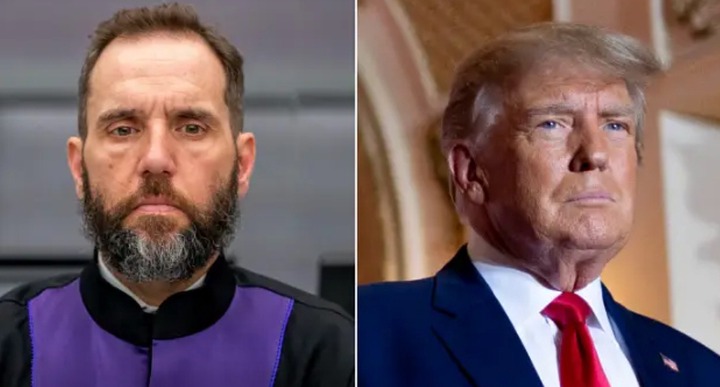
Constitutional law professor Peter Shane, affiliated with New York University, has emerged as a vocal proponent of the legal legitimacy of Special Counsel Jack Smith, countering assertions made by former President Donald Trump. Trump, in a social media post on December 26, questioned the authority of Smith, who is currently overseeing federal indictments against him.
Shane’s analysis draws upon statutory authority, specifically citing 28 USC 515—a federal law granting the attorney general the power to appoint a special counsel for both criminal and civil cases. According to this law, “the attorney general or any other officer of the Department of Justice may conduct any kind of legal proceeding, civil or criminal, including grand jury proceedings.”
Moreover, the law emphasizes the formalities involved in appointing a special counsel, requiring the individual to be sworn in by oath. The language further specifies that each attorney specially retained must be commissioned as a special assistant to the attorney general or special attorney, reinforcing the official and legal nature of the role.
The legal backdrop to this discourse is the indictment of Donald Trump by Jack Smith in August. Trump faces charges related to allegedly attempting to overturn the 2020 election results, leading up to the January 6, 2021, riot at the U.S. Capitol. In a separate case, Smith indicted Trump in June on 37 counts related to the mishandling of classified materials.
Throughout these legal proceedings, Trump has consistently pleaded not guilty, maintaining his innocence. These federal cases are part of a larger legal landscape that Trump navigates as he campaigns for the 2024 primary, positioning himself as the frontrunner for the Republican presidential nomination.
Despite the legal challenges, Trump has framed these cases as a political witch hunt, resonating with a portion of his base and polarizing the discourse surrounding the legal actions he faces.
Trump’s dissatisfaction with Jack Smith’s role as a special prosecutor is evident in his social media posts. On Christmas Eve, he expressed frustration on Truth Social, claiming persecution and interference. On December 26, Trump escalated his critique, asserting that Smith lacks legal authority for the position of special counsel and alleging prosecutorial misconduct.
Notably, on December 20, former President Ronald Reagan’s attorney general, Edwin Meese, filed an amicus brief to the Supreme Court, challenging the legality of Smith’s appointment. Meese, along with Steven Calabresi of the Federalist Society and Gary Lawson, a constitutional law professor at Boston University, argues that only Congress has the authority to create the special counsel position held by Smith.