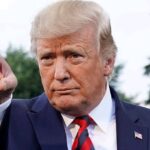
Former President Donald Trump ignited a firestorm of criticism on Saturday during a speech in New Hampshire, where he resurrected divisive rhetoric regarding migrants, prompting comparisons to historical figures like Adolf Hitler and other dictators.
In a statement that stirred controversy, Trump asserted, “They’re poisoning the blood of our country. That’s what they’ve done. They poison mental institutions and prisons all over the world, not just in South America… but all over the world they’re coming into our country from Africa, from Asia, all over the world. They’re pouring into the country,” insinuating a link between immigration and potential terrorism.
MSNBC swiftly addressed Trump’s comments, drawing parallels between his language and that of other political figures like Ron DeSantis and Vivek Ramaswamy. The network highlighted the historically controversial language, raising concerns about the tone of political discourse.
Experts joined the chorus of criticism, with Robert Reich, a professor at Berkeley and former secretary of labor under President Bill Clinton, equating Trump’s rhetoric with the language found in Hitler’s Mein Kampf. Reich remarked, “Claiming that immigrants are ‘poisoning the blood of the country’ is the literal language of Hitler’s Mein Kampf. Trump and his allies are openly embracing fascism, and it’s time for the media to stop being scared to use that word.”
A Twitter account supporting Biden-Harris in 2024 echoed this sentiment, accusing Trump of “echoing Hitler,” adding fuel to the ongoing debate surrounding the appropriateness of certain political expressions and their potential historical implications.
Bill Kristol, a longtime GOP stalwart, delivered a stern message to Republican primary voters, urging them to reject what he called “un-American crap.” Kristol reminded voters of their ancestors’ struggles against similar ideologies, emphasizing that many came to America to escape such divisive rhetoric.
Ruth Ben-Ghiat, a New York University professor and expert on authoritarianism, provided insights into Trump’s potential strategy, suggesting that he might repeat such statements multiple times before the election to solidify their impact. Ben-Ghiat referenced the concept of propaganda and emphasized the importance of repetition in shaping public opinion, drawing a parallel with Tucker Carlson, a prominent Fox News host, and his repeated discussions of the “Great Replacement Theory” on his show.
The controversy surrounding Trump’s remarks extends beyond the immediate political context, raising questions about the boundaries of acceptable language in public discourse. Critics argue that such rhetoric not only stirs division but also evokes historical instances of oppressive ideologies.
The comparison to Hitler’s language in Mein Kampf, a foundational text for the Nazi regime, adds a historical dimension to the critique, heightening concerns about the implications of such language in the present political climate.
This incident serves as a reminder of the broader responsibility borne by political leaders and media figures in shaping public discourse. The power of language to influence public opinion and perceptions is a recurring theme in political history.
As debates unfold over the appropriateness of certain expressions, the public is confronted with the challenge of navigating a political landscape where language can carry profound historical weight. The ongoing discourse surrounding Trump’s comments highlights the need for a nuanced understanding of the impact of language on society and the importance of fostering a political environment that promotes respectful and informed dialogue.