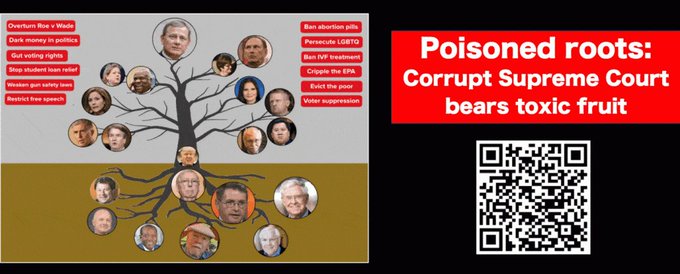
Integrity of the Supreme Court is under scrutiny as allegations of corruption and misconduct raise serious concerns about the institution’s legitimacy. Critics argue that these “poisoned roots” have led to a court that produces “toxic fruit,” undermining public trust and the foundation of the American judicial system.
Recent revelations about potential conflicts of interest, ethical breaches, and partisan influences have fueled these concerns. High-profile cases have spotlighted decisions that appear to reflect political bias rather than impartial justice, leading to widespread skepticism about the court’s independence.
This perception of a compromised Supreme Court has far-reaching implications. It erodes public confidence in the judicial system, a cornerstone of democracy that relies on trust and fairness. When the highest court in the land is seen as corrupt or biased, the very principles of justice and equality are called into question.
Reform advocates are calling for increased transparency, stricter ethical guidelines, and mechanisms to hold justices accountable. They argue that without these measures, the court’s decisions will continue to be viewed with suspicion, further damaging its reputation and effectiveness.
The phrase “toxic fruit” aptly describes the outcomes of a court perceived as corrupt. Decisions that should uphold the rule of law instead deepen societal divisions and contribute to a sense of injustice. This toxic environment can lead to greater political polarization and cynicism among the public.
As debates about the Supreme Court’s integrity continue, the need for systemic reforms becomes increasingly apparent. Ensuring that justices adhere to the highest ethical standards is crucial for restoring faith in the judiciary and maintaining the delicate balance of power within the U.S. government.
In conclusion, the metaphor of “poisoned roots” producing “toxic fruit” encapsulates the critical challenges facing the Supreme Court. Addressing these issues head-on is essential for preserving the court’s role as a fair and impartial arbiter of justice in America.