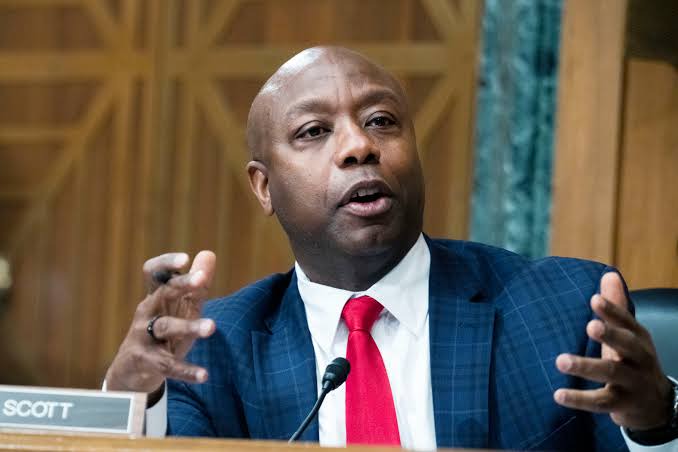
Tim Scott, the South Carolina senator once viewed as a promising presidential candidate, is now grappling with plummeting poll numbers and increasing doubts about the viability of his campaign. Close associates have expressed disappointment with his performance, and even his hometown newspaper has thrown its support behind another Republican, Nikki Haley, to challenge Donald Trump, according to a report by Politico on Sunday, October 22.
Scott’s recent efforts to revive his campaign, including appearances on major news networks, are viewed as a response to his waning prospects. Despite engaging almost exclusively with conservative media for months, he has made recent appearances on CNN, CBS, ABC, and CNBC in an attempt to broaden his reach. However, it remains uncertain whether this change in strategy will be sufficient to salvage his campaign.
The most telling sign of Scott’s challenges lies in his polling numbers, which have dipped below 2 percent in national polls. The urgency for Scott’s campaign to rebound is further highlighted by his hometown newspaper endorsing Nikki Haley as the primary Republican candidate to challenge Trump, not Scott.
Even ardent Scott supporters have acknowledged the lackluster nature of his campaign. Cory Gardner, Scott’s former Senate colleague, who had advised him to appear on a broader range of media outlets, believes that increased visibility could elevate his candidacy. However, Scott’s declining popularity in the polls remains a cause for concern.
Notably, prominent figures within the Republican Party, including Senator John Cornyn, have expressed disappointment in Scott’s performance, despite acknowledging his positive qualities. Cornyn noted that Scott has a compelling message but has struggled to convince Republican voters.
This downward trajectory stands in stark contrast to the high expectations that surrounded Scott’s entry into the race. Early on, high-profile supporters like South Dakota Senator John Thune and billionaire Larry Ellison showed interest. The campaign appeared to be amassing significant financial backing, with Scott’s fundraising efforts initially seen as promising. Just two months ago, Scott had reached double-digit poll numbers in Iowa, positioning himself as a leading alternative to Donald Trump, second only to Ron DeSantis.
However, Scott’s decline began after the first debate, where he struggled to make a significant impact, speaking less than most other candidates. Many supporters identify this debate as a turning point due to Scott’s apparent lack of readiness and the absence of an aggressive earned-media strategy. Since then, Scott’s polling numbers have slipped in key states like Iowa and New Hampshire, as well as nationally.
This decline was further emphasized when his super PAC canceled millions of dollars in fall advertising, raising concerns about the future of his campaign. Although Scott is on track to qualify for the third Republican debate, his previous debate performances have not significantly boosted his standings.
Senator Lindsey Graham pointed out the overshadowing competition with Trump, making it challenging for any candidate to gain substantial traction. Despite this, Graham remains optimistic that Scott could still find a path to success.
Scott’s limited media presence has also contributed to his campaign’s challenges. For weeks, he focused primarily on conservative media, with minimal engagement in national news programs. This lack of an aggressive media strategy and a failure to insert himself into the national conversation hindered his campaign. A supporter of Scott’s campaign pointed out a fundamental miscalculation in understanding the requirements of running for president and generating news coverage. Scott also missed opportunities to use his role in the Senate to create attention-grabbing moments that could bolster his campaign.
Additionally, concerns have been raised about Scott’s campaign spending rate, which significantly exceeded the funds raised during the third quarter. Although his campaign secured a favorable rate for television advertisements, it spent nearly $9 million on television advertising by the end of the third quarter.
Despite these challenges, Scott remains committed to his campaign. He has initiated a bus tour in Iowa and planned to speak at a predominantly African American church in Chicago. Scott’s aligned super PAC has pledged to enhance grassroots efforts following the cancellation of its recent ads.