Former President Donald Trump has made an extraordinary request to the U.S. Supreme Court, urging them to intervene in his forthcoming sentencing concerning 34 convictions linked to business records fraud in New York. The announcement came on Monday, June 3, 2024, as Trump voiced his grievances about the timing of the sentencing, which coincides with the Republican National Convention.
Expressing his frustration on his social media platform, Truth Social, Trump decried what he perceives as politically motivated scheduling designed to disrupt any potential re-election campaign. He asserted, “The ‘Sentencing’ for not having done anything wrong will be, conveniently for the Fascists, 4 days before the Republican National Convention,” adding, “The entire judicial system is rigged against me.”
Trump has consistently maintained that the legal actions against him are part of a broader conspiracy orchestrated by his political adversaries. He specifically targeted the District Attorney overseeing his case, accusing him of being a “Radical Left Soros backed D.A., who ran on a platform of ‘I will get Trump.'” Additionally, Trump criticized the judge involved in his case, describing him as “HIGHLY CONFLICTED” and appointed by Democrats.
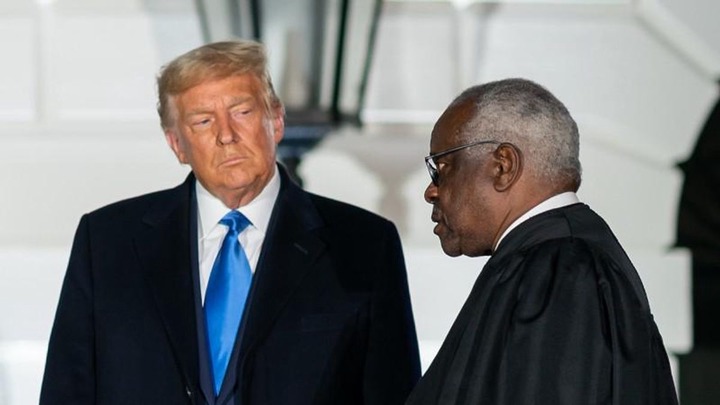
In an unprecedented move, Trump explicitly called on the Supreme Court to intervene and ensure fairness in his trial and subsequent sentencing, declaring, “The United States Supreme Court MUST DECIDE!”
Legal experts have raised concerns about Trump’s plea to the Supreme Court. Politico’s senior legal affairs reporter, Kyle Cheney, highlighted Trump’s explicit request for intervention, noting, “Trump makes it explicit: he wants the US Supreme Court to somehow prevent his sentencing in New York.”
The 34 felony counts against Trump stem from allegations of falsifying business records to conceal hush money payments during his 2016 presidential campaign. These payments were reportedly made to silence individuals with potentially damaging information about Trump, marking the first time a sitting or former U.S. president has been convicted of a crime.
Supporters of Trump have rallied behind his claims of a rigged judicial system, viewing the charges as politically motivated attacks aimed at thwarting his chances of a political resurgence. Many have echoed Trump’s call for the Supreme Court to intervene, arguing that the legal proceedings have been unfairly biased against him.
Conversely, critics argue that Trump is attempting to undermine the judicial process by portraying himself as a victim of political persecution. They contend that the legal proceedings have followed due process and are based on substantial evidence of wrongdoing.

As Trump’s sentencing date approaches, attention will focus on whether the Supreme Court will take any action in response to his plea. Legal experts suggest that such intervention is improbable, as the Supreme Court typically refrains from involvement in lower court sentencing procedures unless significant constitutional issues are at stake.
Nevertheless, Trump’s appeal to the Supreme Court underscores the high stakes involved and the contentious nature of his legal battles. With the Republican National Convention looming, the outcome of his sentencing could have significant ramifications for his political future and the broader political landscape in the United States.
The case also holds broader implications for the U.S. judicial system and the principle of accountability for public officials. If the Supreme Court were to intervene, it could establish a precedent for future cases involving high-profile political figures. Conversely, if the judicial process proceeds without intervention, it could reinforce the notion that no individual is above the law, regardless of their political stature.