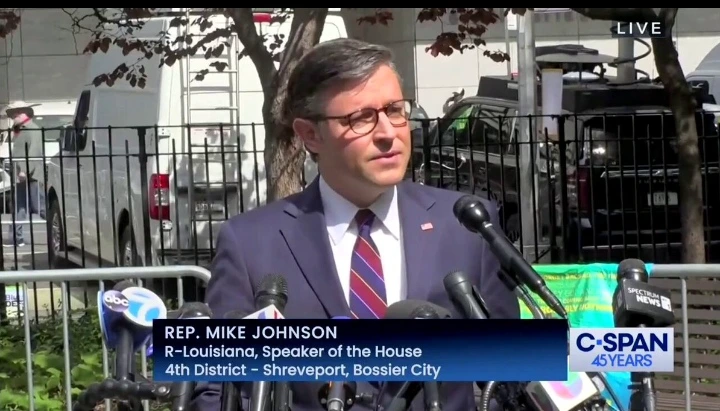
Recent political discourse, Speaker of the House Mike Johnson’s fervent push for a new “election integrity” bill has sparked controversy and skepticism. The bill, purportedly aimed at preventing noncitizens from voting in federal elections, has drawn scrutiny for its lack of substantiated evidence.
Johnson’s bold assertion, claiming widespread illegal voting by noncitizens, was met with incredulity by fellow lawmakers and legal experts alike. U.S. Representative Jasmine Crockett, herself a trained lawyer, couldn’t contain her laughter when confronted with Johnson’s statement. In a candid moment caught on camera, she remarked, “I mean, this guy is a lawyer. Our whole job is to present evidence, and he’s saying ‘I have no evidence of it but in my gut I feel like it’s happening.'”
Eliza Sweren-Becker, senior counsel at the Brennan Center for Justice, echoed Crockett’s sentiments, emphasizing that data disproves Johnson’s claims. Contrary to his assertions, there is little evidence to suggest that noncitizens engage in illegal voting in significant numbers.
Crockett’s colleague, U.S. Representative Ted Lieu, seized on Johnson’s declaration to issue a tongue-in-cheek response, vowing to prevent third graders from voting in federal elections to highlight the absurdity of Johnson’s proposed legislation.
Despite mounting criticism, Johnson remains resolute in his commitment to advancing the bill. However, the absence of concrete evidence supporting his claims has cast doubt on the feasibility and necessity of the proposed legislation.

As the debate surrounding Johnson’s announcement unfolds, it underscores the importance of evidence-based policymaking. In a political landscape marked by polarization and mistrust, factual information and data-driven decisions are paramount.
The skepticism voiced by lawmakers like Crockett and Lieu serves as a poignant reminder of the fundamental role of evidence in shaping policy. Moving forward, the onus is on policymakers to uphold the principles of transparency and accountability, ensuring that legislative initiatives are grounded in empirical reality rather than unsubstantiated conjecture.