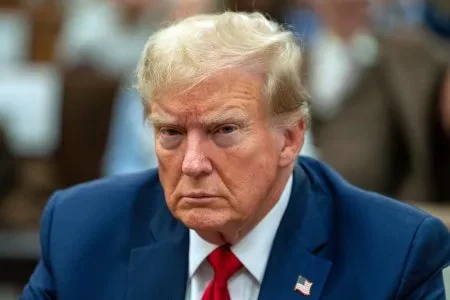
In a potential game-changer for former U.S. President Donald Trump’s 2024 political aspirations, a lower court’s ruling, accusing him of insurrection during the January 6, 2021 Capitol riot, has triggered a legal challenge to his presence on the ballot.

As reported by Newsweek on December 8, 2023, the intriguing turn of events in this case draws parallels to a 1968 ruling involving Eldridge Cleaver, a Peace and Freedom Party presidential candidate excluded from the ballot due to age restrictions.
Derek T. Muller, a law professor at the University of Notre Dame, suggests that historical cases, such as Cleaver’s, could set a precedent for Trump’s potential exclusion. Cleaver, a former Black Panther leader, faced disqualification in California in 1968 due to falling below the minimum age requirement of 35 for presidential candidates.
Muller’s amicus brief emphasizes that states have a historical precedent of excluding candidates who do not meet constitutional qualifications. This legal interpretation challenges Trump’s assertion that states lack the authority to judge candidate qualifications, presenting a historical record of exclusions based on age, citizenship, and loyalty oaths.
Adding nuance to the argument is the fact that California excluded Cleaver despite his eligibility during the presidential term—a detail that enhances the complexity of the case.
While Muller’s brief offers a compelling perspective, it’s crucial to acknowledge the varying historical contexts of each case. Trump’s defense against insurrection claims revolves around the ambiguity of whether the disqualification clause in Section 3 of the 14th Amendment applies to the presidency, forming the core of the legal debate.
District Judge Sarah B. Wallace ruled on November 17 that Trump incited the Capitol riot but left the ballot decision pending due to the unclear applicability of the 14th Amendment. Ongoing appeals highlight the significance of this legal saga, with both Trump and his opponents seeking a favorable outcome.
The parallels drawn between Cleaver’s case and Trump’s situation raise questions about the scope of state authority in determining candidate eligibility. Muller’s acknowledgment of various factors influencing the Colorado Supreme Court’s decision reflects the complexity of the legal landscape surrounding this case.
As the court expedites oral arguments, the outcome remains uncertain. The potential exclusion of Trump from the Colorado ballot hinges on the court’s interpretation of constitutional provisions and historical precedents. Muller suggests a distinct possibility of exclusion but underscores the challenges in meeting the criteria necessary to remove Trump from the 2024 ballot, emphasizing that any factor favoring Trump could sway the decision.
Ultimately, the Colorado Supreme Court’s ruling holds the power to shape not only Trump’s political future but also the interpretation of constitutional provisions regarding candidate eligibility, with implications extending beyond the borders of the swing state.