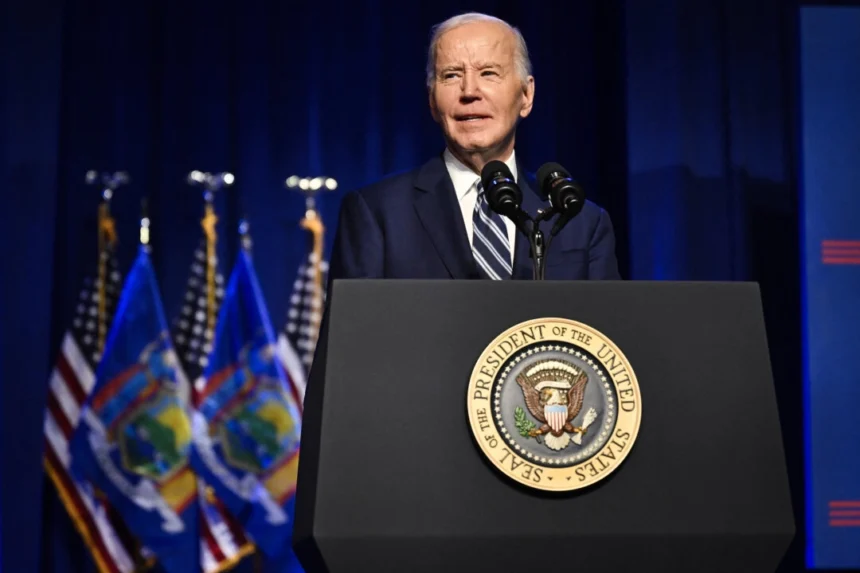
President Joe Biden recently addressed a gathering of American union workers in the Rose Garden, passionately advocating for fair competition in global trade. His focal point? The significant increase in tariffs imposed on various Chinese imports, particularly electric vehicles (EVs) and related products.
In his speech, President Biden underscored the importance of fairness in trade, emphasizing that American workers possess the capability to outperform any competition given a level playing field. He highlighted the long-standing issue of unfair trade practices, attributing them to detrimental effects on the American workforce.
One of the key grievances outlined was the artificially low prices of Chinese goods, ranging from aluminum and semiconductors to critical health equipment and electric vehicles. President Biden pointed out the heavy subsidies provided by the Chinese government to its industries, resulting in an oversupply of products that flood global markets, undercutting competitors.
Moreover, President Biden condemned various anti-competitive tactics employed by China, such as coercing American businesses to transfer technology, share intellectual property, and adhere to majority Chinese ownership requirements. He also referenced documented instances of cyber espionage conducted by Chinese entities.
Characterizing such practices as “cheating,” President Biden announced a series of tariffs aimed at rectifying the imbalance. These tariffs include a 100 percent tariff on Chinese EVs, a 25 percent tariff on electric vehicle batteries and critical minerals, and a 50 percent tariff on Chinese semiconductors. Additionally, tariffs were imposed on Chinese steel and aluminum to address job losses in the ironworking and steelworking sectors.
Highlighting his administration’s commitment to bolstering American industries, President Biden announced substantial investments in clean energy initiatives and infrastructure projects. Notably, he emphasized the importance of American-made electric vehicles, vowing to prioritize their production by union workers.
The decision to impose tariffs garnered support from the union audience, who applauded the president’s stance on protecting American workers and industries. President Biden reiterated his administration’s commitment to fair competition with China, emphasizing the need to abide by international trade laws.
In response to concerns about potential retaliation from China, U.S. Trade Representative Katherine Tai clarified that the tariffs were defensive measures aimed at safeguarding American interests. She emphasized the distinction between defensive subsidies provided by the U.S. government and China’s aggressive tactics to dominate global markets.
Despite China’s condemnation of the tariffs as “bullying” and “political manipulation,” President Biden remains steadfast in his resolve to address longstanding trade imbalances. While acknowledging the possibility of retaliatory measures from China, he expressed confidence in the United States’ ability to navigate such challenges without escalating tensions.
Overall, President Biden’s enforcement of tariffs signals a significant shift towards prioritizing American workers and industries in global trade relations. By taking a stand against unfair trade practices, the administration aims to level the playing field and foster a more equitable economic landscape for all stakeholders.