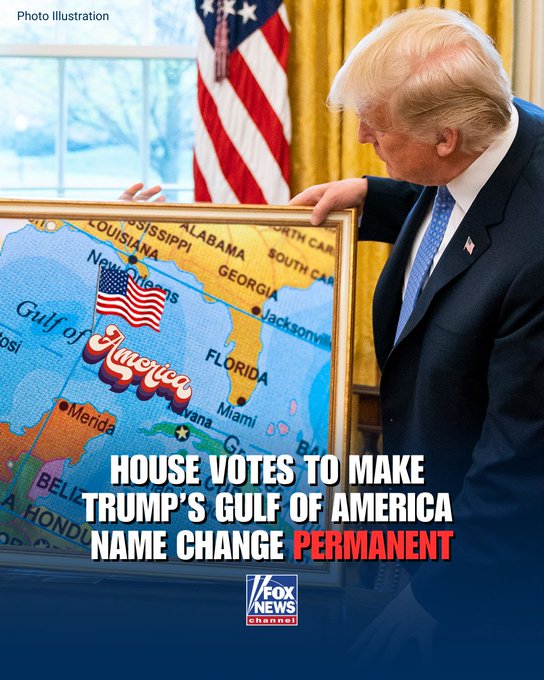
Surprising and controversial development, the U.S. House of Representatives has passed a bill to make President Trump’s proposed renaming of the Gulf of Mexico to the “Gulf of America” permanent. The move has already sparked a heated debate across the country, with supporters hailing it as a patriotic gesture, while critics argue it’s an unnecessary change to a historic name.
The Background of the Name Change Proposal
This proposal is rooted in an idea President Trump floated during his time in office, as part of a broader push to assert American influence and dominance in various areas. The Gulf of Mexico, a body of water bordered by the U.S., Mexico, and several Central American nations, has long held its historical name. However, President Trump expressed a desire to change this, arguing that the name “Gulf of America” would more accurately reflect the United States’ central role in the region.
Supporters of the name change saw it as a step toward showcasing American strength and unity. In their view, renaming the Gulf would send a strong signal of pride and sovereignty, aligning with the broader nationalist sentiment that Trump promoted during his presidency. The Gulf, in their eyes, is a vital waterway for U.S. trade, military presence, and energy resources. Changing its name to the “Gulf of America” could serve as a powerful reminder of American significance on the global stage.
The House Vote and Its Aftermath
The bill to make the name change permanent was introduced in the House of Representatives and, after significant debate, passed by a majority vote. The legislation now heads to the Senate, where it will face further scrutiny before potentially becoming law. While the name change still requires approval from the Senate and ultimately the President, the passage through the House represents a significant milestone in the ongoing push for the renaming.
Supporters of the bill in the House have argued that this change is more than just a symbolic gesture. They claim that it reflects the nation’s pride and the importance of the Gulf to the U.S. economy and security. From military defense, international shipping lanes, oil production, to tourism, the Gulf plays a critical role in many aspects of American life. In their view, calling it the “Gulf of America” could honor that vital connection.
On the other side, opponents have raised concerns about the broader implications of such a change. Critics argue that renaming the Gulf is unnecessary, costly, and could undermine the region’s rich history. The Gulf of Mexico has been known by that name for centuries and holds cultural significance for the countries surrounding it, particularly Mexico, Cuba, and the U.S. southern states. Detractors worry that the rebranding could inflame tensions with neighboring countries, who may see it as an attempt by the U.S. to impose its influence on the region.
Some environmental groups have also voiced their opposition, arguing that the money spent on rebranding could be better used to address pressing environmental issues facing the Gulf, such as oil spills, coastal erosion, and pollution. These critics suggest that instead of focusing on renaming the Gulf, lawmakers should prioritize policies aimed at preserving the region’s ecosystems and mitigating the effects of climate change.
The Symbolic Nature of the Name Change
While the name change might seem trivial to some, the symbolism behind it cannot be ignored. Renaming the Gulf of Mexico to the Gulf of America reflects a broader movement in American politics and culture—one that places a strong emphasis on national pride, sovereignty, and asserting dominance. President Trump’s supporters have consistently called for a reevaluation of American history and the country’s place in the world, with many advocating for changes that reflect a more assertive and unapologetic America.
The idea of renaming geographical landmarks to assert a more nationalistic identity is not new. Similar debates have occurred in various regions of the world, where governments have sought to rename places to reflect a sense of national unity or pride. Whether it’s renaming streets, cities, or natural landmarks, these changes are often seen as a way to affirm cultural values and historical narratives.
However, as in the case of the Gulf of Mexico, such efforts often encounter resistance. Renaming can be seen as an erasure of history, a move that disregards the significance of a place’s original name. For many, the Gulf of Mexico represents not only a body of water but also the intertwined histories of indigenous peoples, colonization, exploration, and trade. Changing the name could, therefore, be viewed as an attempt to rewrite the past in a way that benefits a specific political agenda.
Potential Impact on U.S.-Mexico Relations
One of the most immediate concerns about renaming the Gulf involves its potential impact on U.S.-Mexico relations. The Gulf of Mexico has long been a shared resource, and the relationship between the two countries regarding this body of water is complex. It is home to a diverse ecosystem that includes marine life, coastal communities, and fisheries that are vital to both nations.
For many in Mexico, the name “Gulf of Mexico” represents their cultural and historical connection to the region. A name change could strain diplomatic ties and further fuel the sense of division between the U.S. and Mexico. While the two nations have cooperated on various environmental, trade, and security issues concerning the Gulf, renaming it could be perceived as a step toward eroding that cooperative relationship.
The Senate’s Role and Future of the Bill
Now that the bill has passed the House, all eyes are on the Senate, where it is expected to face more intense scrutiny. Senate members, particularly those from states bordering the Gulf, will likely have a significant influence on the outcome. It remains to be seen whether the Senate will follow the House’s lead or whether they will push back against the proposed change.
If the bill does pass the Senate, it could then be sent to the President for final approval. Given President Trump’s support for the name change, it is likely that he would sign the bill into law, solidifying the “Gulf of America” as the official name for the body of water.
For now, the debate continues, and the Gulf of Mexico remains in the spotlight. Whether or not the bill becomes law, the discussion surrounding the name change is a reflection of larger conversations taking place in the U.S. about national identity, pride, and how the country chooses to position itself in the world.