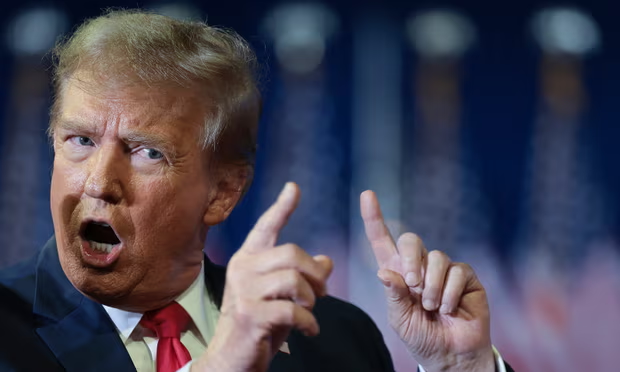
Former President Donald Trump’s recent remarks regarding Vladimir Putin and NATO have stirred widespread condemnation, with many branding them as appalling and unhinged. Trump’s suggestion that Putin should invade NATO countries if they fail to increase their defense spending has been rightly criticized for its reckless nature and potential to endanger global security, as highlighted by NATO Secretary-General Jens Stoltenberg. However, amidst the outrage, there is a need to acknowledge the underlying concerns that Trump’s comments raise about the future of the NATO alliance.
Critics have pointed out the historical context of NATO’s operations, emphasizing instances where the United States has exploited the alliance for its own geopolitical interests, often at the expense of other member states. The costly and prolonged military interventions led by the US, from Afghanistan to Iraq, have underscored the dangers of unchecked American influence within NATO. Trump’s callous invitation for Putin to engage in warfare against NATO is a stark reminder of the perils of such unilateralism.
Despite the alarming nature of Trump’s rhetoric, it prompts a crucial question: Does NATO need to reassess its role and priorities in the modern world? Trump’s consistent advocacy for isolationism reflects a broader sentiment within the US that questions the necessity of prolonged military engagements abroad. He argues that Western nations should focus on addressing domestic challenges rather than intervening in distant conflicts, a sentiment that resonates with many disillusioned with traditional foreign policy approaches.
Moreover, Trump’s critique of NATO’s expansion in the early 2000s, particularly its inclusion of Baltic and Eastern European states, raises legitimate concerns about the alliance’s provocative actions and their implications for regional stability. While NATO’s response to Russian aggression in Ukraine was justified, the current stalemate calls for a reevaluation of the alliance’s long-term objectives. Should NATO continue to be a vehicle for perpetual conflict, or should it pivot towards a more diplomatic and peace-oriented role?
While Trump’s proposal to disband NATO seems extreme and unlikely, it underscores the urgent need for NATO members to engage in meaningful discussions about the alliance’s future. The principle of collective defense enshrined in NATO’s Article 5 warrants reconsideration in light of evolving geopolitical dynamics and shifting global priorities. As the US increasingly focuses its attention on the Pacific region, and Europe grapples with internal divisions, NATO must adapt to remain relevant in a rapidly changing world.
In conclusion, while Trump’s remarks may have been inflammatory and irresponsible, they serve as a catalyst for much-needed reflection on NATO’s purpose and trajectory. As tensions simmer and geopolitical uncertainties loom large, NATO must chart a course that promotes peace, stability, and cooperation, both within its member states and beyond. Only through thoughtful dialogue and strategic planning can NATO fulfill its mandate as a bulwark of security and safeguard against threats to international order.