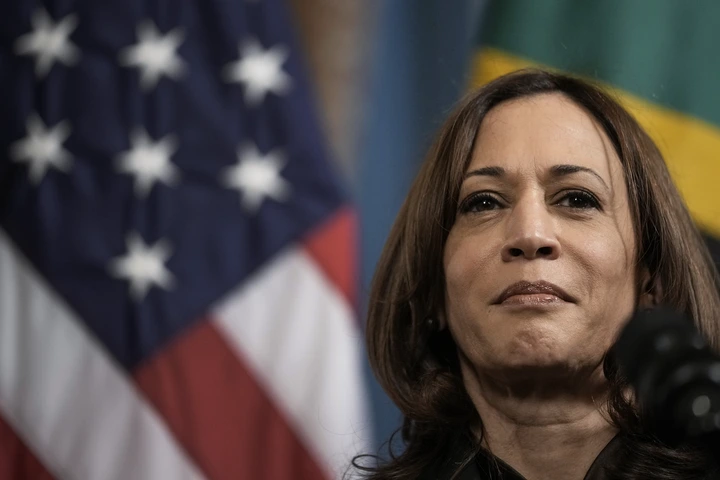
Vice President Kamala Harris has sparked controversy by directly linking the resurgence of Arizona’s historic abortion ban to former President Donald Trump, accusing him of manipulating the situation.
Recently, Arizona’s Supreme Court upheld an almost complete abortion ban dating back to 1864, which predated the state’s establishment. This decision comes in the wake of the 2022 U.S. Supreme Court ruling that overturned Roe v. Wade, stripping federal abortion rights.
Trump, concerned about the potential electoral repercussions of a strong anti-abortion stance, stated the day before the Arizona ruling that he wouldn’t support any federal abortion ban, advocating instead for each state to determine its own laws.
Attempting to distance himself from his previous pro-life stance, Trump characterized Arizona’s revival of the antiquated law as excessive. He asserted that his efforts to overturn Roe were primarily about upholding “states’ rights.”
During a campaign event in Tucson, Harris asserted that Trump bore responsibility for the Arizona law and other similar “Trump abortion bans.” She framed the overturning of Roe as the first step in a broader agenda to erode women’s rights and freedoms.
“We all must understand who is to blame,” Harris emphasized. “Former President Donald Trump did this. During his 2016 campaign, Trump openly stated that women should be punished for seeking an abortion. As president, he deliberately selected three Supreme Court justices with the intent of overturning Roe.”
In response to Harris’s remarks, Trump’s spokesperson emphasized the former president’s stance on leaving such decisions to the states. Trump reiterated this position during a press conference, asserting that his administration’s actions had effectively returned the abortion issue to state control, which he believed was a positive development.
Despite opposition, including efforts by Arizona House Democrats to repeal the ban, Republican legislators stood firm, aligning with Trump’s “states’ rights” approach.
The debate surrounding abortion rights continues to be highly contentious, with politicians on both sides employing rhetoric aimed at shaping public opinion and influencing policy. As the November elections loom, this issue is likely to remain at the forefront of political discourse.